GSC79L15
GSC79L15 is NEGATIVE VOLTAGE REGULATOR manufactured by GTM.
- Part of the GSC79Lxx comparator family.
- Part of the GSC79Lxx comparator family.
..
Pb Free Plating Product
CORPORATION ISSUED DATE :2006/06/26 REVISED DATE :
GSC79LXX
NEGATIVE VOLTAGE REGULATOR
Description
The GSC79LXX series of fixed-voltage monolithic integrated circuit voltage regulators are designed for a wide range of applications. These applications include on-card regulation for elimination of noise and distribution problems associated with single-point regulation. In addition, they can be used with power-pass elements to make high current voltage regulators. Each of these regulators can deliver up to 100m A of output current. The internal limiting and thermal shutdown Features of these regulators make them essentially immune to overload. When used as a replacement for a Zener diode-resistor bination, an effective improvement in output impedance can be obtained together with lower-bias current.
Features
- Fixed output voltage of -5V, -6V, -8V,-9V, -12V, -15V, -18V, -24V
- Internal Short-Circuit Current Limiting
- Internal Thermal Overload Protection
- No External ponents Required
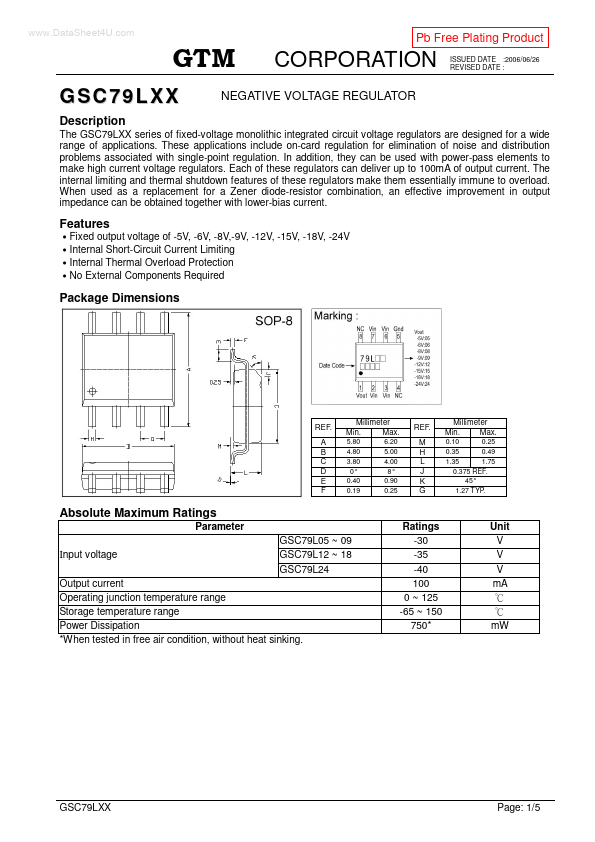
Package Dimensions
REF.
A B C D E F
Millimeter
Min.
Max.
0°
8°
REF.
M H L J K G
Millimeter
Min. Max.
0.375 REF.
45°
1.27...