TL494D
TL494D is Pulse-Width-Modulation Controller manufactured by HTC KOREA.
- Part of the TL494 comparator family.
- Part of the TL494 comparator family.
FEATURES
- plete PWM Power Control Circuitry
- Unmitted Outputs for 200 m A Sink or Source Current
- Output Control Selects Single-Ended or Push-Pull Operation
- Internal Circuitry Prohibits Double Pulse at Either Output
- Variable Dead-Time Provides Control over Total Range
- Internal Regulator Provides a Stable 5-V Reference Supply,5%
- Circuit Architecture Allows Easy Synchronization
- Moisture Sensitivity Level 3
SOP16/DIP16 (TOP VIEW)
NONINV
Error
INPUT
AMP 1
INV INPUT 2
FEEDBACK 3
DEAD-TIME
C1
NONINV INPUT
INV INPUT
Error AMP 2
REF OUT OUTPUT
Vcc C2 E2 E1
DESCRIPTION
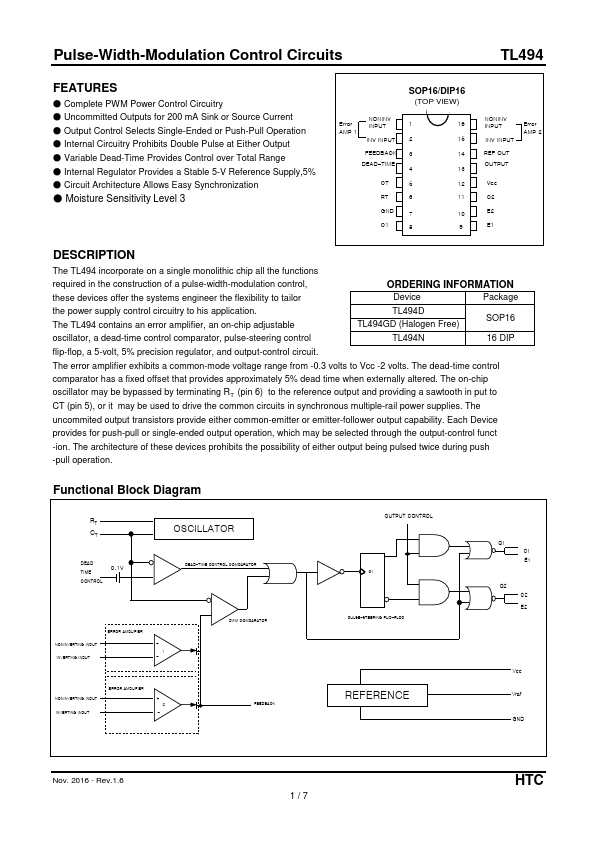
The TL494 incorporate on a single monolithic chip all the functions required in the construction of a pulse-width-modulation control, these devices offer the systems engineer the flexibility to tailor
ORDERING INFORMATION
Device
Package the power supply control circuitry to his application. The TL494 contains an error amplifier, an on-chip adjustable oscillator, a dead-time control parator, pulse-steering control
TL494D TL494GD (Halogen Free)
TL494N
SOP16 16 DIP flip-flop, a 5-volt, 5% precision regulator, and output-control circuit.
The error amplifier exhibits a mon-mode voltage range from -0.3 volts to Vcc -2 volts. The dead-time control parator has a fixed offset that provides approximately 5% dead time when externally altered. The on-chip oscillator may be bypassed by terminating RT (pin 6) to the reference output and providing a sawtooth in put to CT (pin 5), or it may be used to drive the mon circuits in synchronous multiple-rail power supplies. The unmited output transistors provide either mon-emitter or emitter-follower output capability. Each Device provides for push-pull or single-ended output operation, which may be selected through the output-control funct
-ion. The architecture of these devices prohibits the possibility of either output being pulsed twice during...