Datasheet4U Logo Datasheet4U.com

P03C2 - Thyristor Surge Suppressor

Download the P03C2 datasheet PDF. This datasheet also covers the P0300C2 variant, as both devices belong to the same thyristor surge suppressor family and are provided as variant models within a single manufacturer datasheet.

General Description

transmitter,CATV SplitterEtc.

Key Features

  • Compared to surge suppression using other technologies, P0080C2 devices offer absolute surge protection regardless of the surge current available and the rate of applied voltage (dv/dt). P0080C2 devices:.
  • 100% Lead-Free(RoHs Compliant ).
  • Cannot be damaged by voltage.
  • Eliminate hysteresis and heat dissipation typically found with clamping devices.
  • Eliminate voltage overshoot caused by fast-rising transients.
  • Are non-degenerative.
  • Have.

📥 Download Datasheet

Note: The manufacturer provides a single datasheet file (P0300C2-HUAAN.pdf) that lists specifications for multiple related part numbers.

Datasheet Details

Part number P03C2
Manufacturer HUAAN
File Size 321.80 KB
Description Thyristor Surge Suppressor
Datasheet download datasheet P03C2 Datasheet

Full PDF Text Transcription (Reference)

The following content is an automatically extracted verbatim text from the original manufacturer datasheet and is provided for reference purposes only.

View original datasheet text
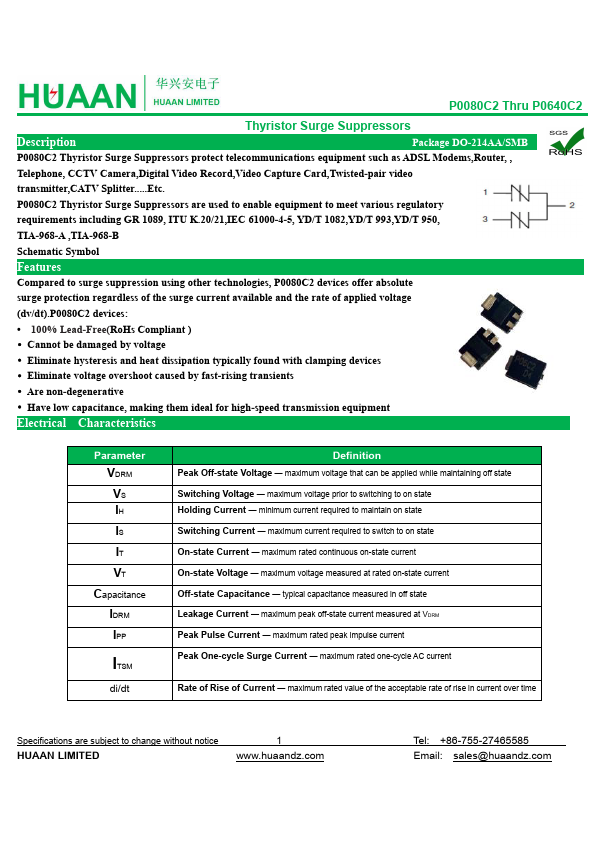
P0080C2 Thru P0640C2 Thyristor Surge Suppressors Description Package DO-214AA/SMB P0080C2 Thyristor Surge Suppressors protect telecommunications equipment such as ADSL Modems,Router, , Telephone, CCTV Camera,Digital Video Record,Video Capture Card,Twisted-pair video transmitter,CATV Splitter.....Etc. P0080C2 Thyristor Surge Suppressors are used to enable equipment to meet various regulatory requirements including GR 1089, ITU K.20/21,IEC 61000-4-5, YD/T 1082,YD/T 993,YD/T 950, TIA-968-A ,TIA-968-B Schematic Symbol Features Compared to surge suppression using other technologies, P0080C2 devices offer absolute surge protection regardless of the surge current available and the rate of applied voltage (dv/dt).