HD74LV126A
HD74LV126A is Quad. Bus Buffer Gates with 3-state Outputs manufactured by Hitachi Semiconductor.
Description
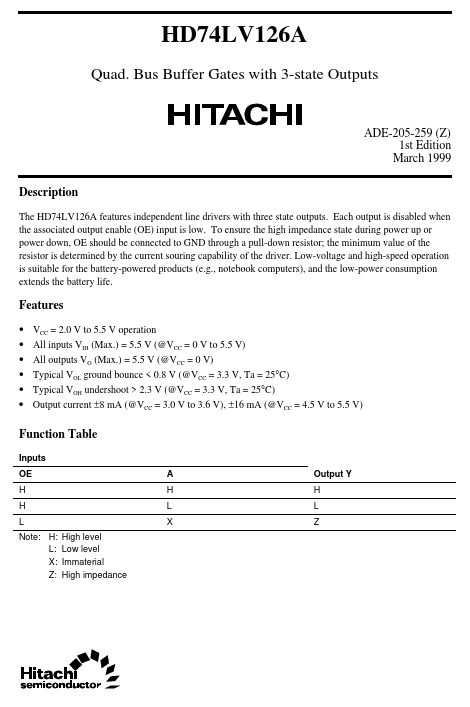
The HD74LV126A features independent line drivers with three state outputs. Each output is disabled when the associated output enable (OE) input is low. To ensure the high impedance state during power up or power down, OE should be connected to GND through a pull-down resistor; the minimum value of the resistor is determined by the current souring capability of the driver. Low-voltage and high-speed operation is suitable for the battery-powered products (e.g., notebook puters), and the low-power consumption extends the battery life.
Features
- -
- -
- - VCC = 2.0 V to 5.5 V operation All inputs VIH (Max.) = 5.5 V (@VCC = 0 V to 5.5 V) All outputs VO (Max.) = 5.5 V (@VCC = 0 V) Typical VOL ground bounce < 0.8 V (@VCC = 3.3 V, Ta = 25°C) Typical VOH undershoot > 2.3 V (@VCC = 3.3 V, Ta = 25°C) Output current ±8 m A (@VCC = 3.0 V to 3.6 V), ±16 m A (@VCC = 4.5 V to 5.5 V)
Function Table
Inputs OE H H L Note: H: L: X: Z: High level Low level Immaterial High impedance A H L X Output Y H L Z
Pin Arrangement
1OE 1 1A 2 1Y 3 2OE 4 2A 5 2Y 6 GND 7
14 VCC 13 4OE 12 4A 11 4Y 10 3OE 9 3A 8 3Y
(Top view)
Absolute Maximum Ratings
Item Supply voltage range Input voltage range-
1 1, 2
Symbol VCC VI VO
Ratings
- 0.5 to 7.0
- 0.5 to 7.0
- 0.5 to VCC + 0.5
- 0.5 to 7.0
Unit V V V
Conditions
Output voltage range-
Output: H or L VCC: OFF or Output: Z
Input clamp current Output clamp current Continuous output current Continuous current through VCC or GND Maximum power dissipation at Ta = 25°C (in still air)- 3
I IK I OK IO I CC or IGND PT
- 20 ±50 ±35 ±70 785 500 m A m A m A m A m W
VI < 0 VO < 0 or VO > VCC VO = 0 to VCC
SOP TSSOP
Storage temperature
Tstg
- 65 to 150
°C
Notes: The absolute maximum ratings are values which must not individually be exceeded, and furthermore, no two of which may be realized at the same time. 1. The input and output voltage ratings may be exceeded if the input and output clamp-current ratings are observed. 2....