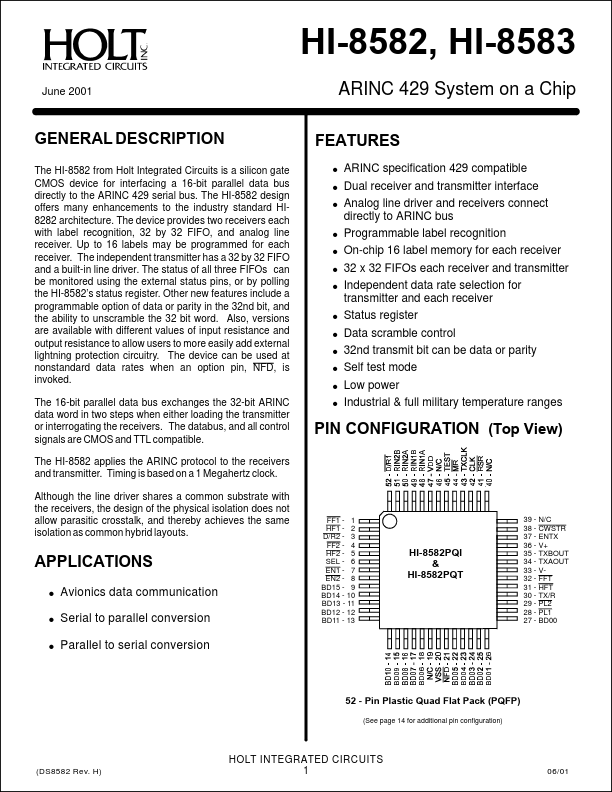
HI-8582
HI-8582 is ARINC 429 SYSTEM ON A CHIP manufactured by Holt Integrated Circuits.
FEATURES
! ARINC specification 429 patible ! Dual receiver and transmitter interface ! Analog line driver and receivers connect directly to ARINC bus ! Programmable label recognition ! On-chip 16 label memory for each receiver ! 32 x 32 FIFOs each receiver and transmitter ! Independent data rate selection for transmitter and each receiver ! Status register ! Data scramble control ! 32nd transmit bit can be data or parity ! Self test mode ! Low power ! Industrial & full military temperature ranges
GENERAL DESCRIPTION
The HI-8582 from Holt Integrated Circuits is a silicon gate CMOS device for interfacing a 16-bit parallel data bus directly to the ARINC 429 serial bus. The HI-8582 design offers many enhancements to the industry standard HI8282 architecture. The device provides two receivers each with label recognition, 32 by 32 FIFO, and analog line receiver. Up to 16 labels may be programmed for each receiver. The independent transmitter has a 32 by 32 FIFO and a built-in line driver. The status of all three FIFOs can be monitored using the external status pins, or by polling the HI-8582’s status register. Other new features include a programmable option of data or parity in the 32nd bit, and the ability to unscramble the 32 bit word. Also, versions are available with different values of input resistance and output resistance to allow users to more easily add external lightning protection circuitry. The device can be used at nonstandard data rates when an option pin, NFD, is invoked. The 16-bit parallel data bus exchanges the 32-bit ARINC data word in two steps when either loading the transmitter or interrogating the receivers. The databus, and all control signals are CMOS and TTL patible. The HI-8582 applies the ARINC protocol to the receivers and transmitter. Timing is based on a 1 Megahertz clock. Although the line driver shares a mon substrate with the receivers, the design of the physical isolation does not allow parasitic crosstalk, and thereby achieves the...