Datasheet4U Logo Datasheet4U.com

IDT54FCT162500AT - FAST CMOS 18-BIT REGISTERED TRANSCEIVER

Download the IDT54FCT162500AT datasheet PDF. This datasheet also covers the IDT54FCT162500 variant, as both devices belong to the same fast cmos 18-bit registered transceiver family and are provided as variant models within a single manufacturer datasheet.

Key Features

  • bit registered transceivers are built using advanced dual metal.
  • Common features: CMOS technology. These high-speed, low-power 18-bit reg-.
  • 0.5 MICRON CMOS Technology istered bus transceivers combine D-type latches and D-type.
  • High-speed, low-power CMOS replacement for flip-flops to allow data flow in transparent, latched and clocked ABT functions.
  • Typical tSK(o) (Output Skew) < 250ps.
  • Low input and output leakage ≤1µA (max. ) modes. Data flo.

📥 Download Datasheet

Note: The manufacturer provides a single datasheet file (IDT54FCT162500_IntegratedDeviceTechnology.pdf) that lists specifications for multiple related part numbers.

Datasheet Details

Part number IDT54FCT162500AT
Manufacturer IDT
File Size 122.55 KB
Description FAST CMOS 18-BIT REGISTERED TRANSCEIVER
Datasheet download datasheet IDT54FCT162500AT Datasheet

Full PDF Text Transcription (Reference)

The following content is an automatically extracted verbatim text from the original manufacturer datasheet and is provided for reference purposes only.

View original datasheet text
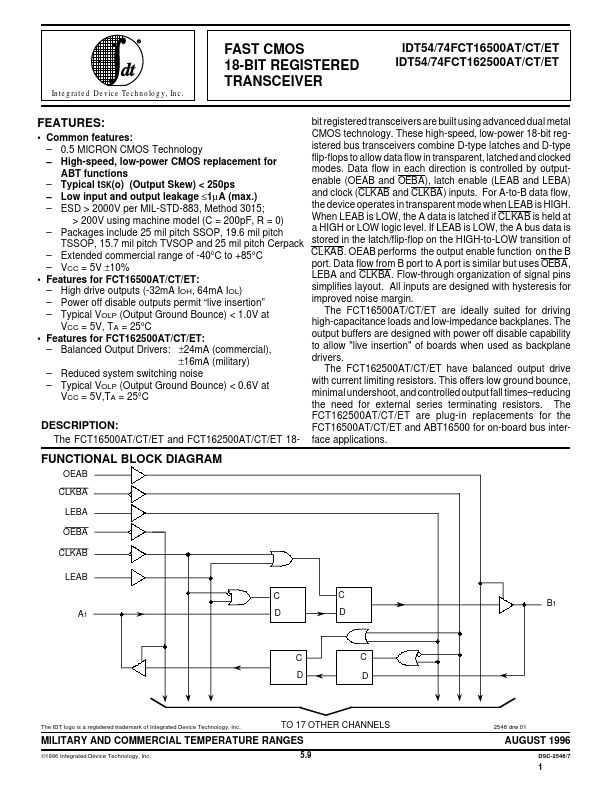
Integrated Device Technology, Inc. FAST CMOS 18-BIT REGISTERED TRANSCEIVER IDT54/74FCT16500AT/CT/ET IDT54/74FCT162500AT/CT/ET FEATURES: bit registered transceivers are built using advanced dual metal • Common features: CMOS technology. These high-speed, low-power 18-bit reg- – 0.5 MICRON CMOS Technology istered bus transceivers combine D-type latches and D-type – High-speed, low-power CMOS replacement for flip-flops to allow data flow in transparent, latched and clocked ABT functions – Typical tSK(o) (Output Skew) < 250ps – Low input and output leakage ≤1µA (max.) modes. Data flow in each direction is controlled by output- enable (OEAB and OEBA), latch enable (LEAB and LEBA) and clock (CLKAB and CLKBA) inputs.