Datasheet4U Logo Datasheet4U.com

IDTF1953NCGI8 - 6-bit Digital Step Attenuator

This page provides the datasheet information for the IDTF1953NCGI8, a member of the IDTF1953 6-bit Digital Step Attenuator family.

Datasheet Summary

Description

This document describes the specification for the IDTF1953 Digital Step Attenuator.

The F1953 is part of a family of Glitch-FreeTM DSAs optimized for the demanding requirements of communications Infrastructure.

Features

  • Glitch-FreeTM, < 0.6 dB transient overshoot.
  • Spurious Free Design.
  • 2.7 to 3.6 V supply.
  • Attenuation Error < 0.5 dB @ 2 GHz.
  • Low Insertion Loss < 1.4 dB @ 2 GHz.
  • Excellent Linearity >+60 dBm IP3I.
  • Fast settling time, < 400 ns.
  • Serial or Parallel Interface 31.5 dB Range.
  • Stable Integral Non-Linearity over temperature.
  • Low Power Consumption < 200 uA.
  • Integrated DC blocking capacitors.
  • Drop-In replacement.
  • 4x4 mm Thin QFN 20 pin packa.

📥 Download Datasheet

Datasheet preview – IDTF1953NCGI8

Datasheet Details

Part number IDTF1953NCGI8
Manufacturer IDT
File Size 1.63 MB
Description 6-bit Digital Step Attenuator
Datasheet download datasheet IDTF1953NCGI8 Datasheet
Additional preview pages of the IDTF1953NCGI8 datasheet.
Other Datasheets by IDT

Full PDF Text Transcription

Click to expand full text
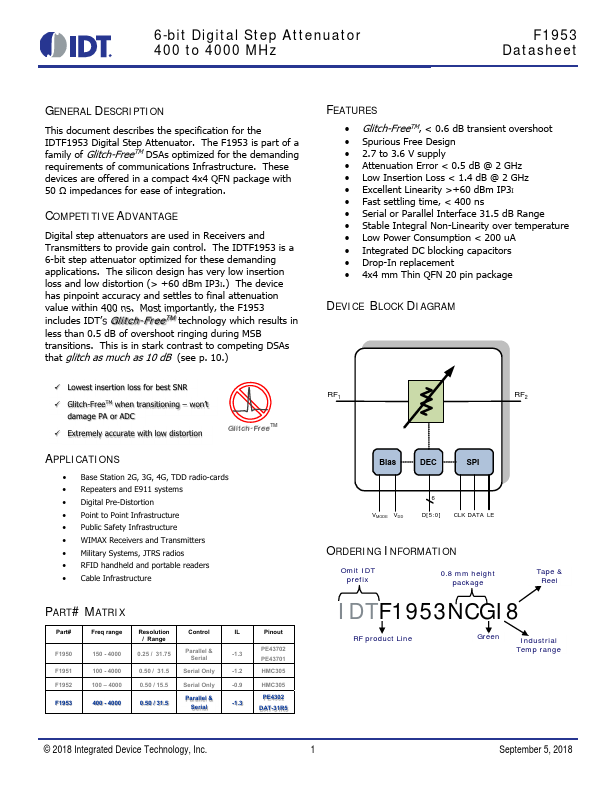
6-bit Digital Step Attenuator 400 to 4000 MHz F1953 Datasheet GENERAL DESCRIPTION This document describes the specification for the IDTF1953 Digital Step Attenuator. The F1953 is part of a family of Glitch-FreeTM DSAs optimized for the demanding requirements of communications Infrastructure. These devices are offered in a compact 4x4 QFN package with 50 Ω impedances for ease of integration. COMPETITIVE ADVANTAGE Digital step attenuators are used in Receivers and Transmitters to provide gain control. The IDTF1953 is a 6-bit step attenuator optimized for these demanding applications. The silicon design has very low insertion loss and low distortion (> +60 dBm IP3I.) The device has pinpoint accuracy and settles to final attenuation value within 400 ns.
Published: |