Datasheet4U Logo Datasheet4U.com

ICS9250-12 - Frequency Generator & Integrated Buffers

Datasheet Summary

Description

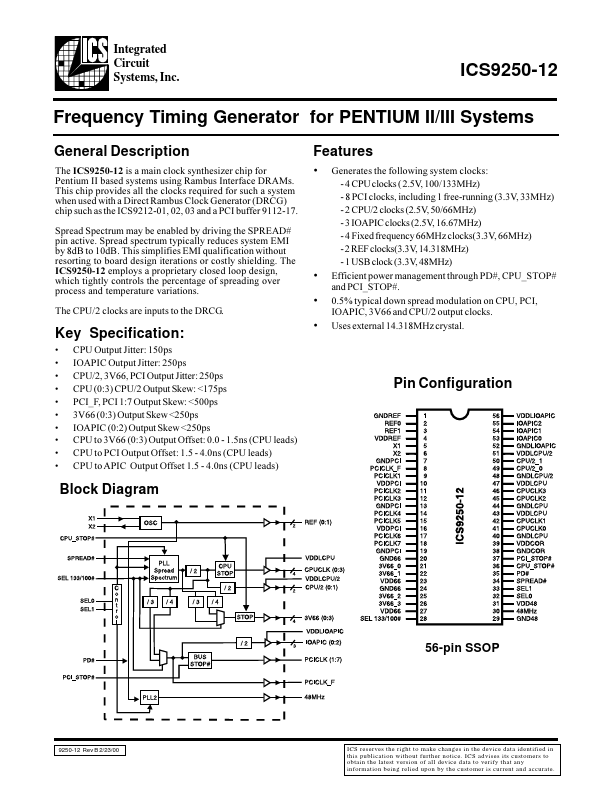
The ICS9250-12 is a main clock synthesizer chip for Pentium II based systems using Rambus Interface DRAMs.

This chip provides all the clocks required for such a system when used with a Direct Rambus Clock Generator (DRCG) chip such as the ICS9212-01, 02, 03 and a PCI buffer 9112-17.

Features

  • • Generates the following system clocks: - 4 CPU clocks ( 2.5V, 100/133MHz) - 8 PCI clocks, including 1 free-running (3.3V, 33MHz) - 2 CPU/2 clocks (2.5V, 50/66MHz) - 3 IOAPIC clocks (2.5V, 16.67MHz) - 4 Fixed frequency 66MHz clocks(3.3V, 66MHz) - 2 REF clocks(3.3V, 14.318MHz) - 1 USB clock (3.3V, 48MHz) Efficient power management through PD#, CPU_STOP# and PCI_STOP#. 0.5% typical down spread modulation on CPU, PCI, IOAPIC, 3V66 and CPU/2 output clocks. Uses external 14.318MHz crystal. • • • K.

📥 Download Datasheet

Datasheet preview – ICS9250-12

Datasheet Details

Part number ICS9250-12
Manufacturer Integrated Circuit Systems
File Size 395.23 KB
Description Frequency Generator & Integrated Buffers
Datasheet download datasheet ICS9250-12 Datasheet
Additional preview pages of the ICS9250-12 datasheet.
Other Datasheets by Integrated Circuit Systems

Full PDF Text Transcription

Click to expand full text
Integrated Circuit Systems, Inc. ICS9250-12 Frequency Timing Generator for PENTIUM II/III Systems General Description The ICS9250-12 is a main clock synthesizer chip for Pentium II based systems using Rambus Interface DRAMs. This chip provides all the clocks required for such a system when used with a Direct Rambus Clock Generator (DRCG) chip such as the ICS9212-01, 02, 03 and a PCI buffer 9112-17. Spread Spectrum may be enabled by driving the SPREAD# pin active. Spread spectrum typically reduces system EMI by 8dB to 10dB. This simplifies EMI qualification without resorting to board design iterations or costly shielding. The ICS9250-12 employs a proprietary closed loop design, which tightly controls the percentage of spreading over process and temperature variations.
Published: |