Datasheet4U Logo Datasheet4U.com

ICS843002I-72 - FEMTOCLOCKS VCXO BASED WCDMA CLOCK GENERATOR/JITTER ATTENUATOR

General Description

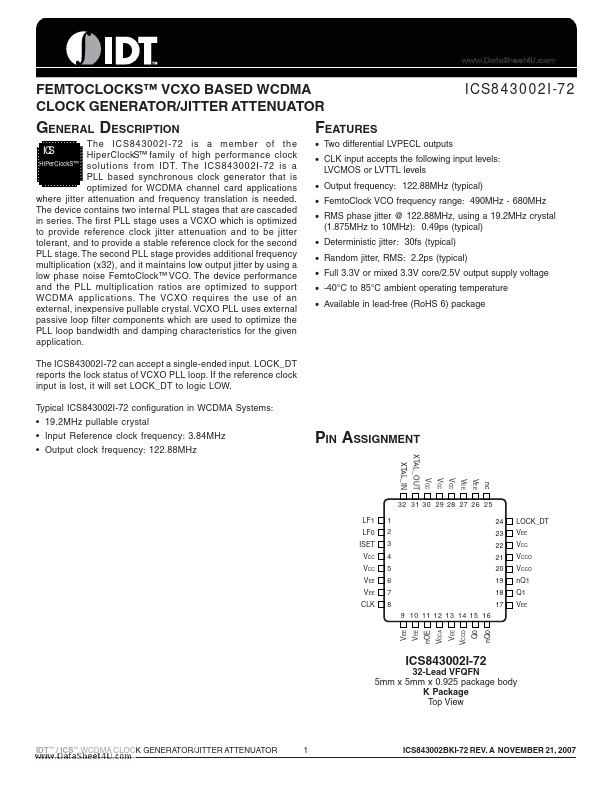
The ICS843002I-72 is a member of the IC S HiperClockS™ family of high performance clock HiPerClockS™ solutions from IDT.

The ICS843002I-72 is a PLL based synchronous clock generator that is optimized for WCDMA channel card applications where jitter attenuation and frequency translation is needed.

Key Features

  • Two differential LVPECL outputs.
  • CLK input accepts the following input levels: LVCMOS or LVTTL levels.
  • Output frequency: 122.88MHz (typical).
  • FemtoClock VCO frequency range: 490MHz - 680MHz.
  • RMS phase jitter @ 122.88MHz, using a 19.2MHz crystal (1.875MHz to 10MHz): 0.49ps (typical).
  • Deterministic jitter: 30fs (typical).
  • Random jitter, RMS: 2.2ps (typical).
  • Full 3.3V or mixed 3.3V core/2.5V output supply voltage.
  • -4.

📥 Download Datasheet

Datasheet Details

Part number ICS843002I-72
Manufacturer Integrated Device Technology
File Size 329.67 KB
Description FEMTOCLOCKS VCXO BASED WCDMA CLOCK GENERATOR/JITTER ATTENUATOR
Datasheet download datasheet ICS843002I-72 Datasheet

Full PDF Text Transcription (Reference)

The following content is an automatically extracted verbatim text from the original manufacturer datasheet and is provided for reference purposes only.

View original datasheet text
www.DataSheet4U.com FEMTOCLOCKS™ VCXO BASED WCDMA CLOCK GENERATOR/JITTER ATTENUATOR ICS843002I-72 GENERAL DESCRIPTION The ICS843002I-72 is a member of the IC S HiperClockS™ family of high performance clock HiPerClockS™ solutions from IDT. The ICS843002I-72 is a PLL based synchronous clock generator that is optimized for WCDMA channel card applications where jitter attenuation and frequency translation is needed. The device contains two internal PLL stages that are cascaded in series. The first PLL stage uses a VCXO which is optimized to provide reference clock jitter attenuation and to be jitter tolerant, and to provide a stable reference clock for the second PLL stage.