Datasheet4U Logo Datasheet4U.com

ICS874003-05 - PCI EXPRESS JITTER ATTENUATOR

General Description

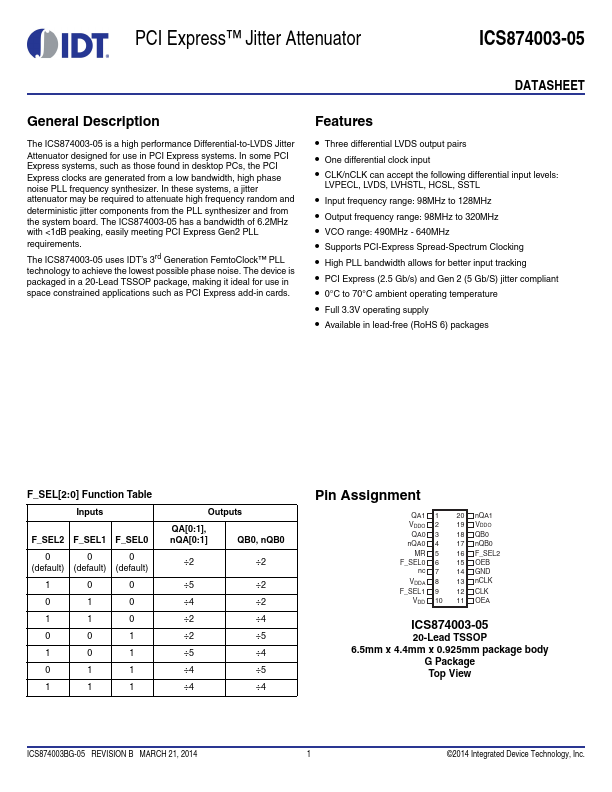
The ICS874003-05 is a high performance Differential-to-LVDS Jitter Attenuator designed for use in PCI Express systems.

In some PCI Express systems, such as those found in desktop PCs, the PCI Express clocks are generated from a low bandwidth, high phase noise PLL frequency synthesizer.

Key Features

  • Three differential LVDS output pairs.
  • One differential clock input.
  • CLK/nCLK can accept the following differential input levels: LVPECL, LVDS, LVHSTL, HCSL, SSTL.
  • Input frequency range: 98MHz to 128MHz.
  • Output frequency range: 98MHz to 320MHz.
  • VCO range: 490MHz - 640MHz.
  • Supports PCI-Express Spread-Spectrum Clocking.
  • High PLL bandwidth allows for better input tracking.
  • PCI Express (2.5 Gb/s) and Gen 2 (5 Gb/S) jitt.

📥 Download Datasheet

Datasheet Details

Part number ICS874003-05
Manufacturer Integrated Device Technology
File Size 394.72 KB
Description PCI EXPRESS JITTER ATTENUATOR
Datasheet download datasheet ICS874003-05 Datasheet

Full PDF Text Transcription (Reference)

The following content is an automatically extracted verbatim text from the original manufacturer datasheet and is provided for reference purposes only.

View original datasheet text
PCI Express™ Jitter Attenuator ICS874003-05 DATASHEET General Description The ICS874003-05 is a high performance Differential-to-LVDS Jitter Attenuator designed for use in PCI Express systems. In some PCI Express systems, such as those found in desktop PCs, the PCI Express clocks are generated from a low bandwidth, high phase noise PLL frequency synthesizer. In these systems, a jitter attenuator may be required to attenuate high frequency random and deterministic jitter components from the PLL synthesizer and from the system board. The ICS874003-05 has a bandwidth of 6.2MHz with <1dB peaking, easily meeting PCI Express Gen2 PLL requirements. The ICS874003-05 uses IDT’s 3rd Generation FemtoClock™ PLL technology to achieve the lowest possible phase noise.