Download PVG613 Datasheet PDF
International Rectifier
PVG613
PVG613 is Power MOSFET Photovoltaic Relay manufactured by International Rectifier.
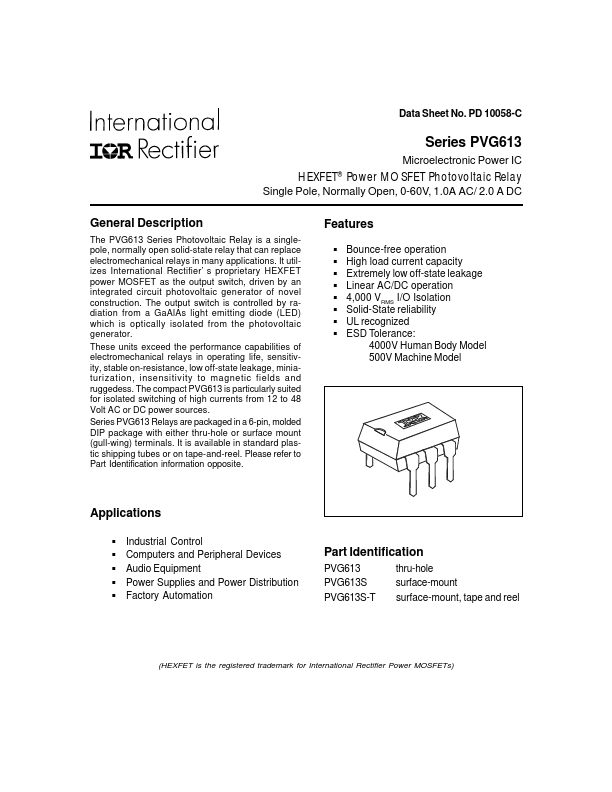
Data Sheet No. PD 10058-C Series PVG613 Microelectronic Power IC HEXFET Power MOSFET Photovoltaic Relay ® Single Pole, Normally Open, 0-60V, 1.0A AC/ 2.0 A DC General Description The PVG613 Series Photovoltaic Relay is a singlepole, normally open solid-state relay that can replace electromechanical relays in many applications. It utilizes International Rectifier’s proprietary HEXFET power MOSFET as the output switch, driven by an integrated circuit photovoltaic generator of novel construction. The output switch is controlled by radiation from a Ga Al As light emitting diode (LED) which is optically isolated from the photovoltaic generator. These units exceed the performance capabilities of electromechanical relays in operating life, sensitivity, stable on-resistance, low off-state leakage, miniaturization, insensitivity to magnetic fields and ruggedess. The pact PVG613 is particularly suited for isolated switching of high currents from 12 to 48 Volt AC or DC power sources. Series PVG613 Relays are packaged in a 6-pin, molded DIP package with either thru-hole or surface mount (gull-wing) terminals. It is available in standard plastic shipping tubes or on tape-and-reel. Please refer to Part Identification information opposite. Features ! ! ! ! ! ! ! ! Bounce-free operation High load current capacity Extremely low off-state leakage Linear AC/DC operation 4,000 VRMS I/O Isolation Solid-State reliability UL recognized ESD Tolerance: 4000V Human Body Model 500V Machine Model Applications ! ! ! ! ! Industrial Control puters and Peripheral Devices Audio Equipment Power Supplies and Power Distribution Factory Automation Part Identification PVG613 PVG613S PVG613S-T thru-hole surface-mount surface-mount, tape and reel (HEXFET is the registered trademark for International Rectifier Power MOSFETs) Series PVG613 Electrical Specifications (-40°C ≤ TA ≤ +85°C unless otherwise specified) INPUT CHARACTERISTICS Minimum Control Current (see figure 1) Maximum Control...