Datasheet4U Logo Datasheet4U.com

ISL6545A - 5V or 12V Single Synchronous Buck Pulse-Width Modulation Controller

Download the ISL6545A datasheet PDF. This datasheet also covers the ISL6545 variant, as both devices belong to the same 5v or 12v single synchronous buck pulse-width modulation controller family and are provided as variant models within a single manufacturer datasheet.

Key Features

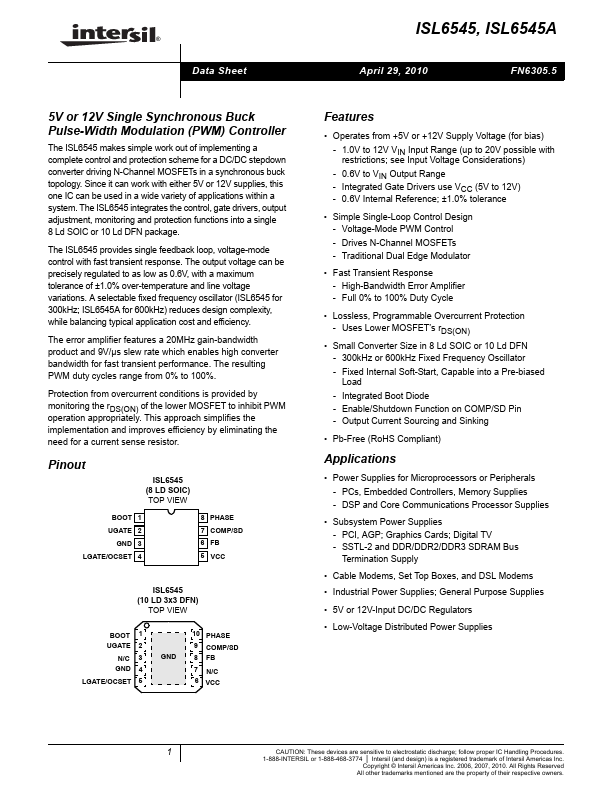
  • a 20MHz gain-bandwidth product and 9V/µs slew rate which enables high converter bandwidth for fast transient performance. The resulting PWM duty cycles range from 0% to 100%. Protection from overcurrent conditions is provided by monitoring the rDS(ON) of the lower MOSFET to inhibit PWM operation appropriately. This approach simplifies the implementation and improves efficiency by eliminating the need for a current sense resistor. Pinout ISL6545 (8 LD SOIC) TOP VIEW BOOT 1 UGATE 2 GND 3 LGATE/.

📥 Download Datasheet

Note: The manufacturer provides a single datasheet file (ISL6545-Intersil.pdf) that lists specifications for multiple related part numbers.

Full PDF Text Transcription (Reference)

The following content is an automatically extracted verbatim text from the original manufacturer datasheet and is provided for reference purposes only.

View original datasheet text
® Data Sheet ISL6545, ISL6545A April 29, 2010 FN6305.5 5V or 12V Single Synchronous Buck Pulse-Width Modulation (PWM) Controller The ISL6545 makes simple work out of implementing a complete control and protection scheme for a DC/DC stepdown converter driving N-Channel MOSFETs in a synchronous buck topology. Since it can work with either 5V or 12V supplies, this one IC can be used in a wide variety of applications within a system. The ISL6545 integrates the control, gate drivers, output adjustment, monitoring and protection functions into a single 8 Ld SOIC or 10 Ld DFN package. The ISL6545 provides single feedback loop, voltage-mode control with fast transient response. The output voltage can be precisely regulated to as low as 0.6V, with a maximum tolerance of ±1.