KKA3354
KKA3354 is IC manufactured by Kodenshi AUK Group.
Description
The bipolar monolithic integrated circuit triggers, monitors and turns-off RF-oscillation of an electronic ballast for fluorescent lamps dependent on several controland monitoring functions.
Features
Minimum wiring plexity Overtemperature protection without external ponents Malfunction detection Timer output Automatical reignition after lamp change
Pinning
Pin 1 Pin 2 Pin 3 Pin 4 Pin 5 Pin 6 Pin 7 Pin 8 TM CT TR GND EI LW S
VCC temperature mode selection clock generator trigger output, turn-off attenuation, oscillation detector connection to ground error indication input input of lamp change switching output of the timer supply voltage
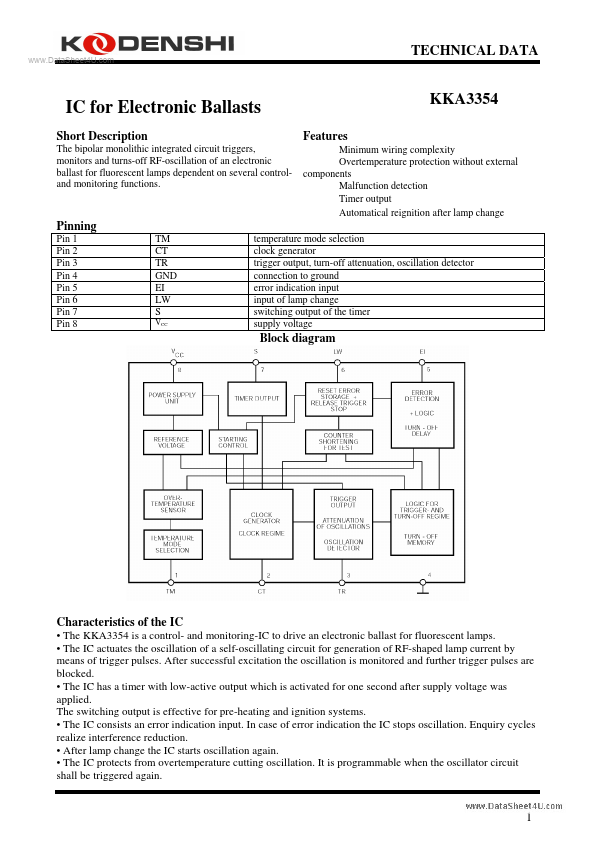
Block diagram
Characteristics of the IC
- The KKA3354 is a control- and monitoring-IC to drive an electronic ballast for fluorescent lamps.
- The IC actuates the oscillation of a self-oscillating circuit for generation of RF-shaped lamp current by means of trigger pulses. After successful excitation the oscillation is monitored and further trigger pulses are blocked.
- The IC has a timer with low-active output which is activated for one second after supply voltage was applied. The switching output is effective for pre-heating and ignition systems.
- The IC consists an error indication input. In case of error indication the IC stops oscillation. Enquiry cycles realize interference reduction.
- After lamp change the IC starts oscillation again.
- The IC protects from overtemperature cutting oscillation. It is programmable when the oscillator circuit shall be triggered again.
..
Functional Description
At the moment of current feeding at terminal VCC, the IC generates the supply voltage via backup capacitor externally connected. As soon as an internal switching threshold of 7 V is reached, trigger pulses are delivered at the output TR with a repetition instalment of 960 µs. After successful triggering of the oscillator circuit, an oscillation detector guarantees blocking of further trigger pulses....