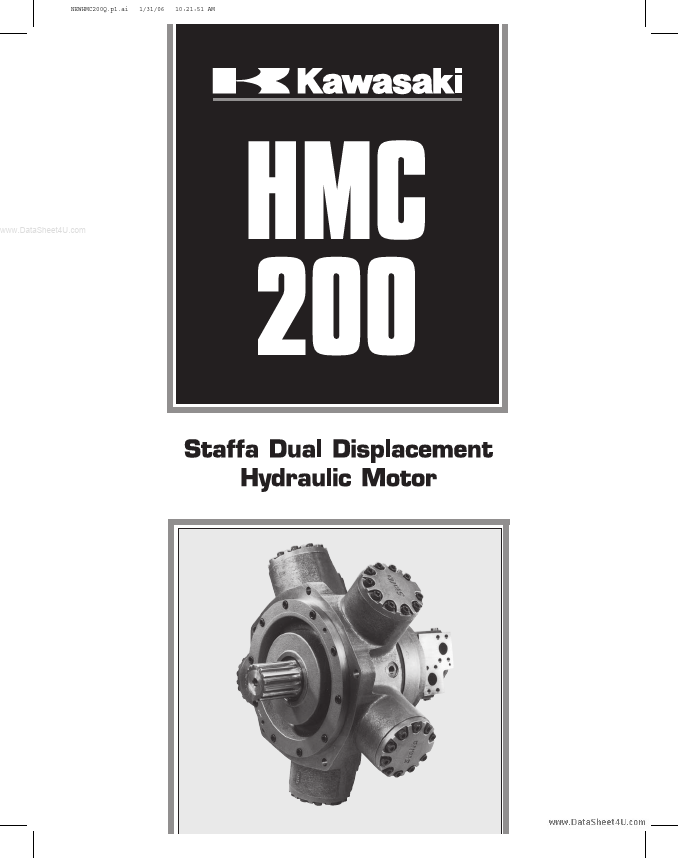
HMC200
HMC200 is Staffa Dual Displacement Hydraulic Motor manufactured by Kawasaki.
NEWHMC200Q.p1.ai
1/31/06
10:21:51 AM
..
HMC200Q
10/28/04
8:39 AM
Page 2
CONTENTS
1. 2. 3. 4.
Page
1. GENERAL DESCRIPTION
Kawasaki “Staffa” high torque, low speed radial piston motors use hydrostatic balancing techniques to achieve high efficiency, bined with good breakout torque and smooth running capability. The HMC series dual displacement models have two pre-set displacements which can be chosen from a wide range to suit specific application requirements. The displacements are hydraulically selected by a directional control valve which can be remote from, or mounted directly on, the motor. Displacements can be changed when the motor is running. The range of HMC motors extends from the HMC030 of 492 cm3 (30 in3) to the HMC325 of 5330 cm3 (325 in3) displacement. These motors are also available in a continuously variable version using either hydro-mechanical or electrohydraulic control methods. Other mounting options are available on request to match many of the petitor interfaces.
5.
..
6. 7. 8. 9. 10. 11. 12.
13.
General Description ................................ 2 Functional Symbols ................................ 2 Model Code ................................................. 3 Performance Data: Motor selection ......................................... 4 Rating definitions ..................................... 4 Output torques .......................................... 5 Bearing life .................................................. 6 Volumetric efficiency ............................. 6 Circuit and Application Notes: Displacement selection ........................ 7 Starting torques ........................................ 7 Low speed operation ............................ 7 Small displacements ............................. 7 High back pressure ................................ 7 Boost pressure .......................................... 7 Cooling flow ................................................ 8 Motor...