Datasheet4U Logo Datasheet4U.com

ML620Q503 - Ultra Low Power 16-bit Microcontroller

General Description

This LSI family is a high-performance 16-bit CMOS microcontroller into which rich peripheral circuits, such as synchronous serial port, UART, I2C bus interface (master), supply voltage level detect circuit, RC oscillation type A/D converter, and successive approximation type A/D converter are incorp

Key Features

  • CPU.
  • 16-bit RISC CPU (CPU name: nX-U16/100).
  • Instruction system: 16-bit instructions.
  • Instruction set: Transfer, arithmetic operations, comparison, logic operations, multiplication/division, bit manipulations, bit logic operations, jump, conditional jump, call return stack manipulations, arithmetic shift, and so on.
  • Build-in On-Chip debug function.
  • Minimum instruction execution time 30.5 µs (@32.768 kHz system clock) 62.5ns (@16 MHz system.

📥 Download Datasheet

Datasheet Details

Part number ML620Q503
Manufacturer LAPIS Semiconductor
File Size 920.83 KB
Description Ultra Low Power 16-bit Microcontroller
Datasheet download datasheet ML620Q503 Datasheet

Full PDF Text Transcription (Reference)

The following content is an automatically extracted verbatim text from the original manufacturer datasheet and is provided for reference purposes only.

View original datasheet text
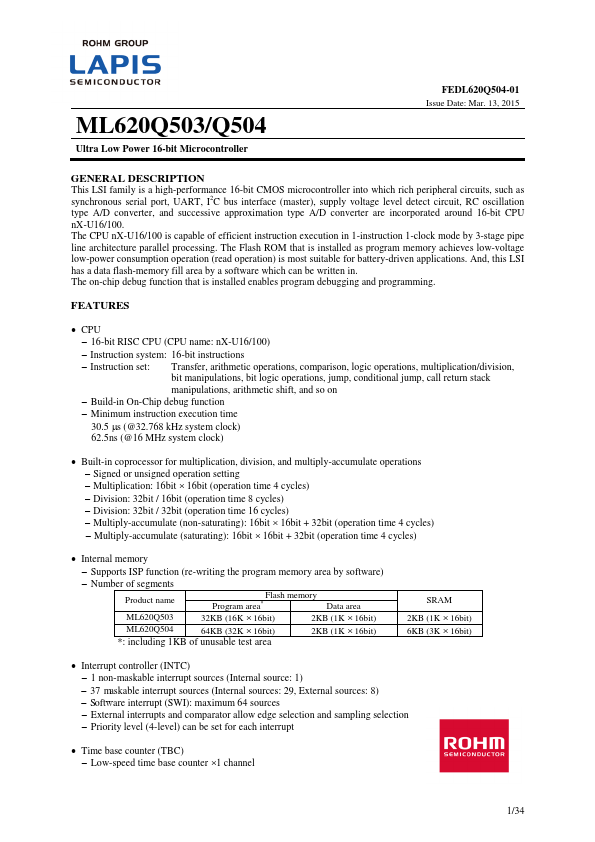
ML620Q503/Q504 Ultra Low Power 16-bit Microcontroller FEDL620Q504-01 Issue Date: Mar. 13, 2015 GENERAL DESCRIPTION This LSI family is a high-performance 16-bit CMOS microcontroller into which rich peripheral circuits, such as synchronous serial port, UART, I2C bus interface (master), supply voltage level detect circuit, RC oscillation type A/D converter, and successive approximation type A/D converter are incorporated around 16-bit CPU nX-U16/100. The CPU nX-U16/100 is capable of efficient instruction execution in 1-instruction 1-clock mode by 3-stage pipe line architecture parallel processing. The Flash ROM that is installed as program memory achieves low-voltage low-power consumption operation (read operation) is most suitable for battery-driven applications.