Datasheet4U Logo Datasheet4U.com

LX304C - 1x Ultra Low Power Mobile EMI Reduction

This page provides the datasheet information for the LX304C, a member of the LX304 1x Ultra Low Power Mobile EMI Reduction family.

Datasheet Summary

Description

The LX304 is a versatile 1x Active EMI management IC designed to provide system wide reduction of Electromagnetic Interference (EMI) and Radio Frequency Interference (RFI) from clock and data sources.

Features

  • FCC approved method of EMI attenuation.
  • Proprietary “SaΦic™” technology, a non-PLL phase controlled Active EMI management architecture.
  • Generates a 1X low EMI Phase Modulated replication of the input signal.
  • Vdd 1.65V - 2.0V 10 MHz to 38 MHz.
  • Vdd 2.5V - 3.6V 10 MHz to 38 MHz.
  • Multiple Deviation Selections.
  • Minimum frequency deviation selection capability.
  • Power Down Mode.
  • 8-pin WDFN package.
  • Supports automotive reliability standard: AEC-Q100 Gra.

📥 Download Datasheet

Datasheet preview – LX304C

Datasheet Details

Part number LX304C
Manufacturer LFC semi
File Size 1.48 MB
Description 1x Ultra Low Power Mobile EMI Reduction
Datasheet download datasheet LX304C Datasheet
Additional preview pages of the LX304C datasheet.
Other Datasheets by LFC semi

Full PDF Text Transcription

Click to expand full text
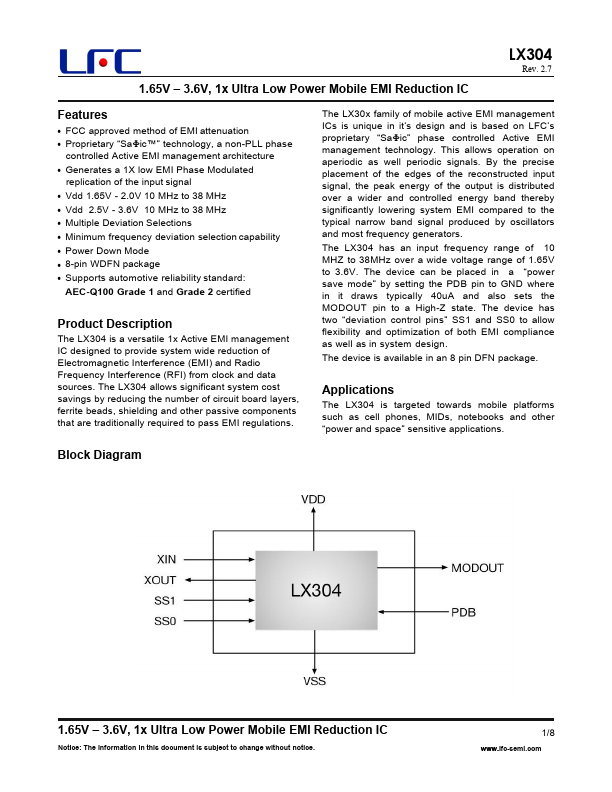
1.65V – 3.6V, 1x Ultra Low Power Mobile EMI Reduction IC LX304 Rev. 2.7 Features  FCC approved method of EMI attenuation  Proprietary “SaΦic™” technology, a non-PLL phase controlled Active EMI management architecture  Generates a 1X low EMI Phase Modulated replication of the input signal  Vdd 1.65V - 2.0V 10 MHz to 38 MHz  Vdd 2.5V - 3.6V 10 MHz to 38 MHz  Multiple Deviation Selections  Minimum frequency deviation selection capability  Power Down Mode  8-pin WDFN package  Supports automotive reliability standard: AEC-Q100 Grade 1 and Grade 2 certified Product Description The LX304 is a versatile 1x Active EMI management IC designed to provide system wide reduction of Electromagnetic Interference (EMI) and Radio Frequency Interference (RFI) from clock and data sources.
Published: |