DESCRIPTION
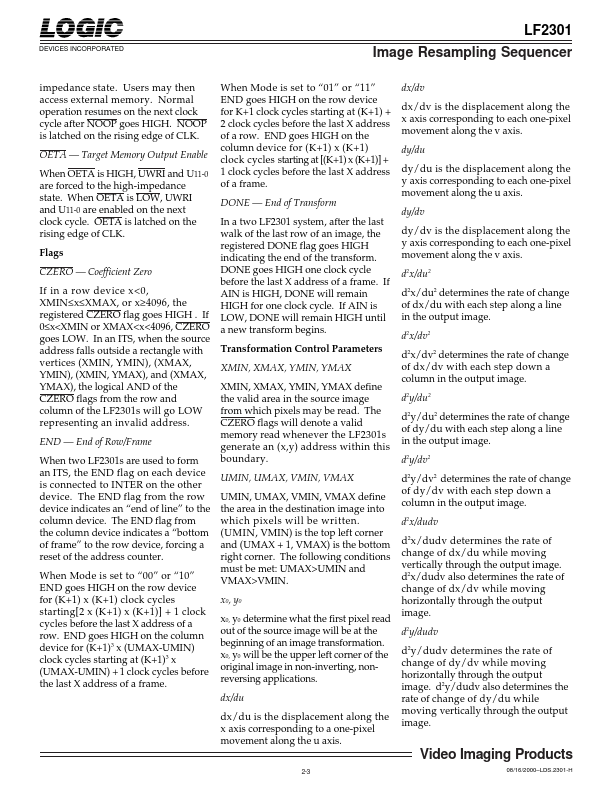
By using two LF2301s in a Image Transformation System (ITS), nearest-neighbor, bilinear interpolation, and cubic convolution algorithms, with kernel sizes up to 4 x 4 pixels, are all possible (see Figure 1). DETAILS OF OPERATION Most video applications use a pair of LF2301s in tandem to construct an ITS. One LF2301 is the row coordinate generator (x to u) and the other is the column generator (y to v). External RAM is needed for storage of the interpolation coefficient lookup table, as well as for buffers of the source and destination images. An external MultiplierAccumulator is required when performing interpolation or implementing static filters. The ITS is capable of performing the general second-order coordinate transformation of the form: x(u,v) = Au 2+Bu+Cuv+Dv2+Ev+F y(u,v) = Gu2+Hu+Kuv+Lv2+Mv+N where parameters A through N of the transform are user-defined. The system steps sequentially through each pixel in the “target” image lying within a user-defined rectangle. For each “target” pixel at (u,v), the LF2301 points to a corresponding “source” pixel at (x,y). LOGIC Devices Incorporated