LS7232ND
Key Features
- Phase-lock loop synchronization allows use in Wall Switch applications.
- Provides brightness control of incandescent lamps with touch plates or pushbutton switches.
- Controls the duty cycle from 23% to 88% (conduction angles for AC half-cycles between 41˚ and 158˚, respectively.)
- Operates at 50Hz/60Hz line frequency.
- Extension input for remote activation.
- +12V to +18V Power Supply voltage (VSS - VDD).
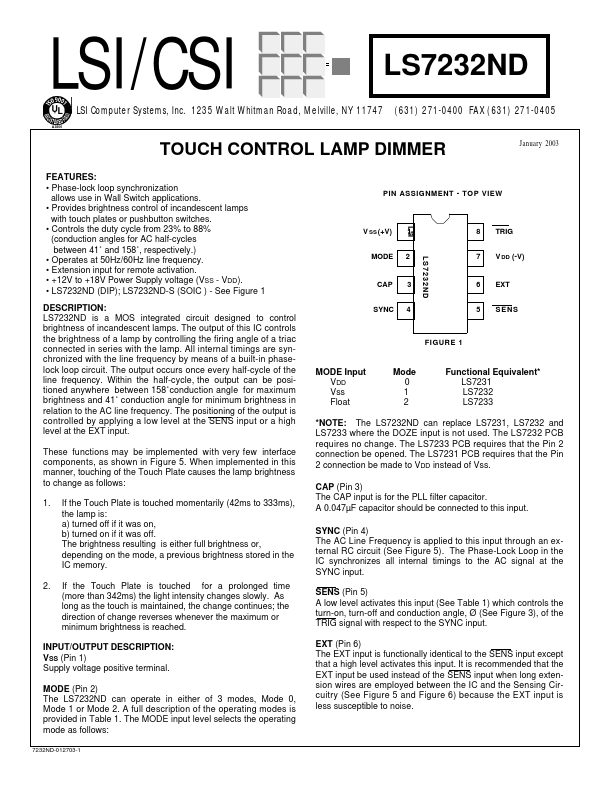
- LS7232ND (DIP); LS7232ND-S (SOIC ) - See Figure 1 DESCRIPTION: LS7232ND is a MOS integrated circuit designed to control brightness of incandescent lamps. The output of this IC controls the brightness of a lamp by controlling the firing angle of a triac connected in series with the lamp. All internal timings are synchronized with the line frequency by means of a built-in phaselock loop circuit. The output occurs once every half-cycle of the line frequency. Within the half-cycle, the output can be positioned anywhere between 158˚conduction angle for maximum brightness and 41˚ conduction angle for minimum brightness in relation to the AC line frequency. The positioning of the output is controlled by applying a low level at the SENS input or a high level at the EXT input. These functions may be implemented with very few interface components, as shown in Figure
- When implemented in this manner, touching of the Touch Plate causes the lamp brightness to change as follows:
- If the Touch Plate is touched momentarily (42ms to 333ms), the lamp is: a) turned off if it was on, b) turned on if it was off. The brightness resulting is either full brightness or, depending on the mode, a previous brightness stored in the IC memory. If the Touch Plate is touched for a prolonged time (more than 342ms) the light intensity changes slowly. As long as the touch is maintained, the change continues; the direction of change reverses whenever the maximum or minimum brightness is reached.