OR3T30
Key Features
- High-performance, cost-effective, 0.35 µm (OR3C) and 0.3 µm (OR3T) 4-level metal technology, (4- or 5-input look-up table delay of 1.1 ns with -7 speed grade in 0.3 µm). Same basic architecture as lower-voltage, advanced process technology Series 3 architectures. (See ORCA Series 3L FPGA documentation.) Up to 186,000 usable gates. Up to 452 user I/Os. (OR3Txxx I/Os are 5 V tolerant to allow interconnection to both 3.3 V and 5 V devices, selectable on a per-pin basis.) Pin selectable I/O clamping diodes provide 5 V or 3.3 V PCI compliance and 5 V tolerance on OR3Txxx devices. Twin-quad programmable function unit (PFU) architecture with eight 16-bit look-up tables (LUTs) per PFU, organized in two nibbles for use in nibble- or byte-wide functions. Allows for mixed arithmetic and logic functions in a single PFU. Nine user registers per PFU, one following each LUT, plus one extra. All have programmable clock enable and local set/reset, plus a global set/reset that can be disabled per PFU. Flexible input structure (FINS) of the PFUs provides a routability enhancement for LUTs with shared inputs and the logic flexibility of LUTs with independent inputs. Fast-carry logic and routing to adjacent PFUs for nibble-, byte-wide, or longer arithmetic functions, with the option to register the PFU carry-out. Softwired LUTs (SWL) allow fast cascading of up to three levels of LUT logic in a single PFU for up to 40% speed improvement. Supplemental logic and interconnect cell (SLIC) provides 3-statable buffers, up to 10-bit decoder, and PAL*like AND-OR with optional INVERT in each programma- * * * * * * *
- ble logic cell (PLC), with over 50% speed improvement typical. Abundant hierarchical routing resources based on routing two data nibbles and two control lines per set provide for faster place and route implementations and less routing delay. TTL or CMOS input levels programmable per pin for the OR3Cxx (5.0 V) devices. Individually programmable drive capability: 12 mA sink/6 mA source or 6 mA sink/3 mA source. Built-in boundary scan (IEEE † 1149.1 JTAG) and TS_ALL testability function to 3-state all I/O pins. Enhanced system clock routing for low skew, high-speed clocks originating on-chip or at any I/O. Up to four ExpressCLK inputs allow extremely fast clocking of signals on- and off-chip plus access to internal general clock routing. StopCLK feature to glitchlessly stop/start ExpressCLKs independently by user command. Programmable I/O (PIO) has: - Fast-capture input latch and input flip-flop (FF) latch for reduced input setup time and zero hold time. - Capability to (de)multiplex I/O signals. - Fast access to SLIC for decodes and PAL-like functions. - Output FF and two-signal function generator to reduce CLK to output propagation delay. - Fast open-drain dive capability - Capability to register 3-state enable signal. Baseline FPGA family used in Series 3+ FPSCs (field programmable system chips) which combine FPGA logic and standard cell logic on one device.
- PAL is a trademark of Advanced Micro Devices, Inc. † IEEE is a registered trademark of The Institute of Electrical and Electronics Engineers, Inc. Table
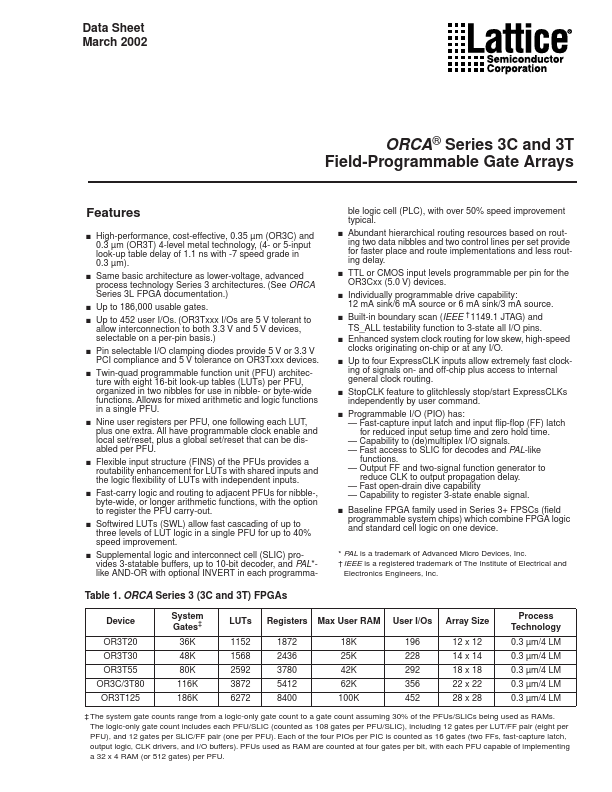
- ORCA Series 3 (3C and 3T) FPGAs Device OR3T20 OR3T30 OR3T55 OR3C/3T80 OR3T125 System Gates‡ 36K 48K 80K 116K 186K LUTs 1152 1568 2592 3872 6272 Registers 1872 2436 3780 5412 8400 Max User RAM 18K 25K 42K 62K 100K User I/Os 196 228 292 356 452 Array Size 12 x 12 14 x 14 18 x 18 22 x 22 28 x 28 Process Technology 0.3 µm/4 LM 0.3 µm/4 LM 0.3 µm/4 LM 0.3 µm/4 LM 0.3 µm/4 LM ‡ The system gate counts range from a logic-only gate count to a gate count assuming 30% of the PFUs/SLICs being used as RAMs. The logic-only gate count includes each PFU/SLIC (counted as 108 gates per PFU/SLIC), including 12 gates per LUT/FF pair (eight per PFU), and 12 gates per SLIC/FF pair (one per PFU). Each of the four PIOs per PIC is counted as 16 gates (two FFs, fast-capture latch, output logic, CLK drivers, and I/O buffers). PFUs used as RAM are counted at four gates per bit, with each PFU capable of implementing a 32 x 4 RAM (or 512 gates) per PFU. ispORCA Series 3C and 3T FPGAs Data Sheet March 2002 Table of Contents Contents Page Contents Page