LT3972
LT3972 is 2.4MHz Step-Down Switching Regulator manufactured by Linear Technology.
33V, 3.5A, 2.4MHz Step-Down Switching Regulator with 75µA Quiescent Current
Features
- Wide Input Range: Operation from 3.6V to 33V Overvoltage Lockout Protects Circuits Through 62V Transients
- 3.5A Maximum Output Current
- Low Ripple (<15m VP-P) Burst Mode® Operation:
IQ = 75μA at 12VIN to 3.3VOUT
- Adjustable Switching Frequency: 200k Hz to 2.4MHz
- Low Shutdown Current: IQ < 1μA
- Integrated Boost Diode
- Synchronizable Between 250k Hz to 2MHz
- Power Good Flag
- Saturating Switch Design: 95mΩ On-Resistance
- Output Voltage: 0.79V to 30V
- Thermal Protection
- Soft-Start Capability
- Small 10-Pin Thermally Enhanced MSOP and
(3mm × 3mm) DFN Packages
APPLICATIONS
- Automotive Battery Regulation
- Distributed Supply Regulation
- Industrial Supplies
- Wall Transformer Regulation
DESCRIPTION
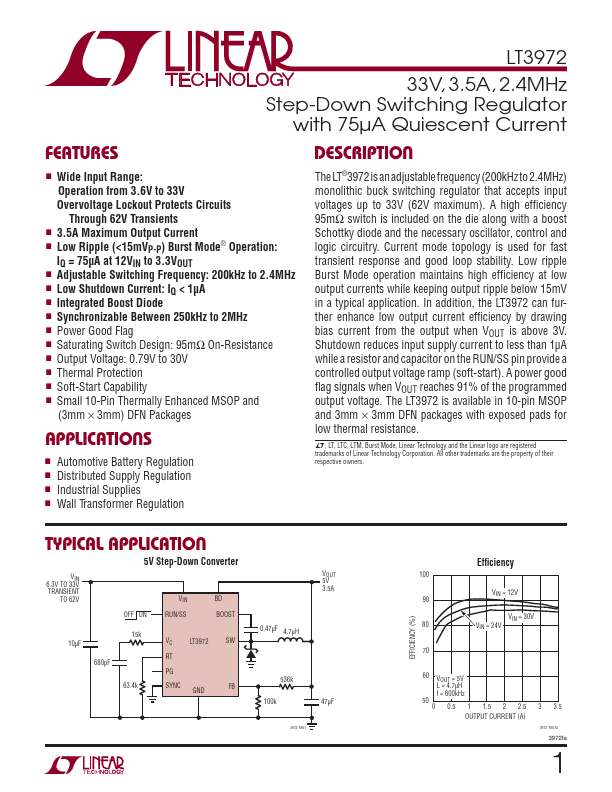
The LT®3972 is an adjustable frequency (200k Hz to 2.4MHz) monolithic buck switching regulator that accepts input voltages up to 33V (62V maximum). A high efficiency 95mΩ switch is included on the die along with a boost Schottky diode and the necessary oscillator, control and logic circuitry. Current mode topology is used for fast transient response and good loop stability. Low ripple Burst Mode operation maintains high efficiency at low output currents while keeping output ripple below 15m V in a typical application. In addition, the LT3972 can further enhance low output current efficiency by drawing bias current from the output when VOUT is above 3V. Shutdown reduces input supply current to less than 1μA while a resistor and capacitor on the RUN/SS pin provide a controlled output voltage ramp (soft-start). A power good flag signals when VOUT reaches 91% of the programmed output voltage. The LT3972 is available in 10-pin MSOP and 3mm × 3mm DFN packages with exposed pads for low thermal resistance.
L, LT, LTC, LTM, Burst Mode, Linear Technology and the Linear logo are registered trademarks of Linear Technology Corporation. All other trademarks are the property of their...