LT8609S
LT8609S is 2A/3A Peak Synchronous Step-Down Regulator manufactured by Linear Technology.
42V, 2A/3A Peak Synchronous Step-Down Regulator with 2.5µA Quiescent Current
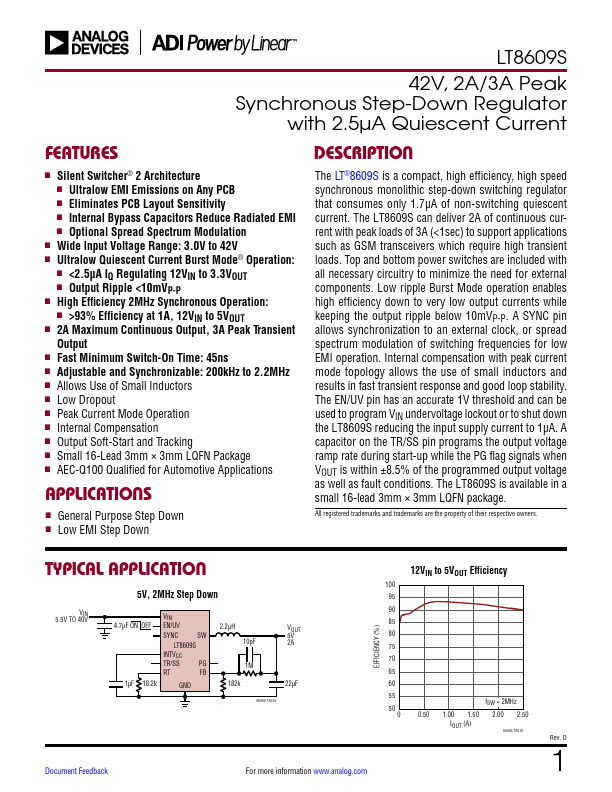
Features n Silent Switcher® 2 Architecture n Ultralow EMI Emissions on Any PCB n Eliminates PCB Layout Sensitivity n Internal Bypass Capacitors Reduce Radiated EMI n Optional Spread Spectrum Modulation n Wide Input Voltage Range: 3.0V to 42V n Ultralow Quiescent Current Burst Mode® Operation: n <2.5µA IQ Regulating 12VIN to 3.3VOUT n Output Ripple <10m VP-P n High Efficiency 2MHz Synchronous Operation: n >93% Efficiency at 1A, 12VIN to 5VOUT n 2A Maximum Continuous Output, 3A Peak Transient Output n Fast Minimum Switch-On Time: 45ns n Adjustable and Synchronizable: 200k Hz to 2.2MHz n Allows Use of Small Inductors n Low Dropout n Peak Current Mode Operation n Internal pensation n Output Soft-Start and Tracking n Small 16-Lead 3mm × 3mm LQFN Package n AEC-Q100 Qualified for Automotive Applications
APPLICATIONS n General Purpose Step Down n Low EMI Step Down
DESCRIPTION
The LT®8609S is a pact, high efficiency, high speed synchronous monolithic step-down switching regulator that consumes only 1.7µA of non-switching quiescent current. The LT8609S can deliver 2A of continuous current with peak loads of 3A (<1sec) to support applications such as GSM transceivers which require high transient loads. Top and bottom power switches are included with all necessary circuitry to minimize the need for external ponents. Low ripple Burst Mode operation enables high efficiency down to very low output currents while keeping the output ripple below 10m VP-P. A SYNC pin allows synchronization to an external clock, or spread spectrum modulation of switching frequencies for low EMI operation. Internal pensation with peak current mode topology allows the use of small inductors and results in fast transient response and good loop stability. The EN/UV pin has an accurate 1V threshold and can be used to program VIN undervoltage lockout or to shut down the LT8609S reducing the input supply current...