LTC2351-14
LTC2351-14 is 1.5Msps Simultaneous Sampling ADC manufactured by Linear Technology.
Features
6-Channel, 14-Bit, 1.5Msps Simultaneous Sampling ADC with Shutdown
DESCRIPTION n 1.5Msps ADC with Six Simultaneously Sampled Differential Inputs n 250ksps Throughput per Channel n 75d B SINAD n Low Power Dissipation: 16.5m W n 3V Single Supply Operation n 2.5V Internal Bandgap Reference, Can Be Overdriven with External Reference n 3-Wire SPI-patible Serial Interface n Internal Conversion Triggered by CONV n Sleep (12μW) Shutdown Mode n NAP (4.5m W) Shutdown Mode n 0V to 2.5V Unipolar, or ±1.25V Bipolar Differential
Input Range n 83d B mon Mode Rejection n Tiny 32-Pin (5mm × 5mm) QFN Package
APPLICATIONS n Multiphase Power Measurement n Multiphase Motor Control n Data Acquisition Systems n Uninterruptable Power Supplies
L, LT, LTC and LTM are registered trademarks of Linear Technology Corporation. All other trademarks are the property of their respective owners. Protected by U.S. Patents, including 6084440, 6522187.
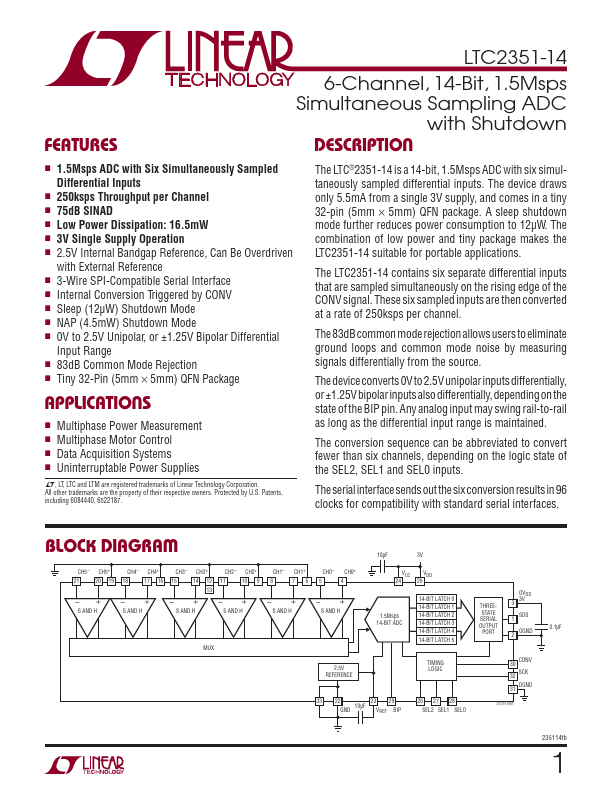
The LTC®2351-14 is a 14-bit, 1.5Msps ADC with six simultaneously sampled differential inputs. The device draws only 5.5m A from a single 3V supply, and es in a tiny 32-pin (5mm × 5mm) QFN package. A sleep shutdown mode further reduces power consumption to 12μW. The bination of low power and tiny package makes the LTC2351-14 suitable for portable applications.
The LTC2351-14 contains six separate differential inputs that are sampled simultaneously on the rising edge of the CONV signal. These six sampled inputs are then converted at a rate of 250ksps per channel.
The 83d B mon mode rejection allows users to eliminate ground loops and mon mode noise by measuring signals differentially from the source.
The device converts 0V to 2.5V unipolar inputs differentially, or ±1.25V bipolar inputs also differentially, depending on the state of the BIP pin. Any analog input may swing rail-to-rail as long as the differential input range is maintained.
The conversion sequence can be abbreviated to convert fewer than six channels,...