LTC2439-1
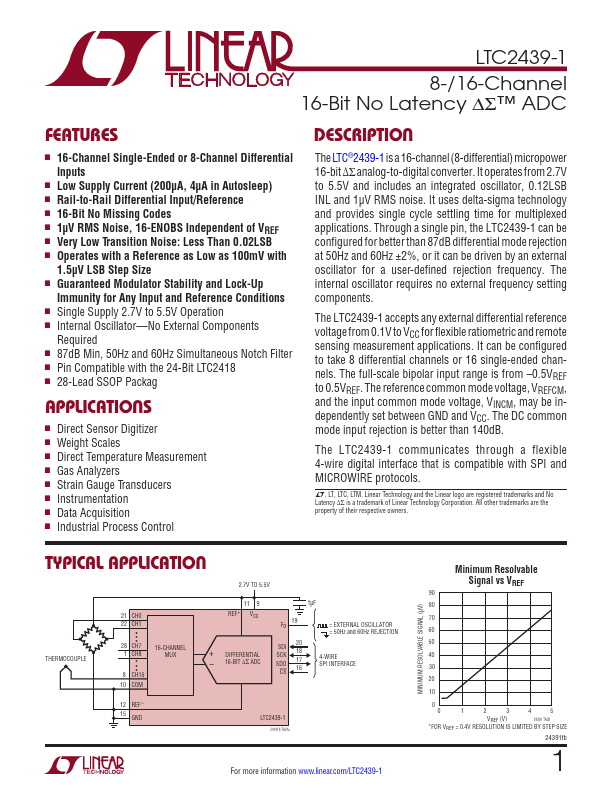
LTC2439-1 is 8-/16-Channel 16-Bit No Latency Delta-Sigma ADC manufactured by Linear Technology.
LTC2439-1 8-/16-Channel 16-Bit No Latency ∆Σ™ ADC
Features
DESCRIPTION nn 16-Channel Single-Ended or 8-Channel Differential Inputs nn Low Supply Current (200µA, 4µA in Autosleep) nn Rail-to-Rail Differential Input/Reference nn 16-Bit No Missing Codes nn 1µV RMS Noise, 16-ENOBS Independent of VREF nn Very Low Transition Noise: Less Than 0.02LSB nn Operates with a Reference as Low as 100m V with
1.5µV LSB Step Size nn Guaranteed Modulator Stability and Lock-Up
Immunity for Any Input and Reference Conditions nn Single Supply 2.7V to 5.5V Operation nn Internal Oscillator- No External ponents
Required nn 87d B Min, 50Hz and 60Hz Simultaneous Notch Filter nn Pin patible with the 24-Bit LTC2418 nn 28-Lead SSOP Packag
APPLICATIONS nn Direct Sensor Digitizer nn Weight Scales nn Direct Temperature Measurement nn Gas Analyzers nn Strain Gauge Transducers nn Instrumentation nn Data Acquisition nn Industrial Process Control
The LTC®2439-1 is a 16-channel (8-differential) micropower 16-bit ∆Σ analog-to-digital converter. It operates from 2.7V to 5.5V and includes an integrated oscillator, 0.12LSB INL and 1µV RMS noise. It uses delta-sigma technology and provides single cycle settling time for multiplexed applications. Through a single pin, the LTC2439-1 can be configured for better than 87d B differential mode rejection at 50Hz and 60Hz ±2%, or it can be driven by an external oscillator for a user-defined rejection frequency. The internal oscillator requires no external frequency setting ponents. The LTC2439-1 accepts any external differential reference voltage from 0.1V to VCC for flexible ratiometric and remote sensing measurement applications. It can be configured to take 8 differential channels or 16 single-ended channels. The full-scale bipolar input range is from
- 0.5VREF to 0.5VREF. The reference mon mode voltage, VREFCM, and the input mon mode voltage, VINCM, may be independently set between GND and VCC. The DC mon mode input rejection is better than...