LTC2489
LTC2489 is 16-Bit 2-/4-Channel ADC manufactured by Linear Technology.
16-Bit 2-/4-Channel DΣ ADC with Easy Drive Input Current Cancellation and I2C Interface
Features
Description n Up to 2 Differential or 4 Single-Ended Inputs n Easy Drive TM Technology Enables Rail-to-Rail
Inputs with Zero Differential Input Current n Directly Digitizes High Impedance Sensors with
Full Accuracy n 2-Wire I2C Interface with 9 Addresses Plus One
Global Address for Synchronization n 600n V RMS Noise (0.02LSB Transition Noise) n GND to VCC Input/Reference mon Mode Range n Simultaneous 50Hz/60Hz Rejection n 2ppm INL, No Missing Codes n 1ppm Offset and 15ppm Full-Scale Error n No Latency: Digital Filter Settles in a Single Cycle,
Even After a New Channel is Selected n Single Supply, 2.7V to 5.5V Operation (0.8m W) n Internal Oscillator n Tiny 4mm × 3mm DFN Package
Applications n Direct Sensor Digitizer n Direct Temperature Measurement n Instrumentation n Industrial Process Control
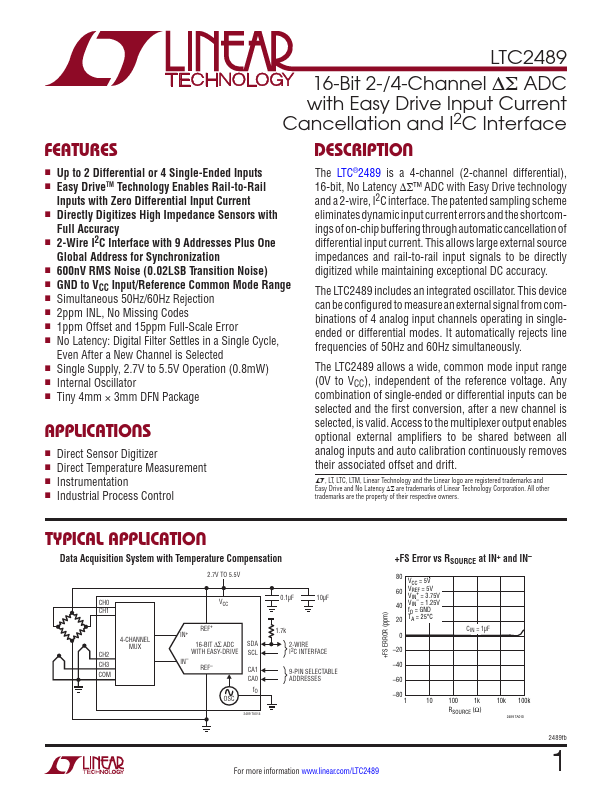
The LTC®2489 is a 4-channel (2-channel differential), 16-bit, No Latency DS™ ADC with Easy Drive technology and a 2-wire, I2C interface. The patented sampling scheme eliminates dynamic input current errors and the shortings of on-chip buffering through automatic cancellation of differential input current. This allows large external source impedances and rail-to-rail input signals to be directly digitized while maintaining exceptional DC accuracy. The LTC2489 includes an integrated oscillator. This device can be configured to measure an external signal from binations of 4 analog input channels operating in singleended or differential modes. It automatically rejects line frequencies of 50Hz and 60Hz simultaneously. The LTC2489 allows a wide, mon mode input range (0V to VCC), independent of the reference voltage. Any bination of single-ended or differential inputs can be selected and the first conversion, after a new channel is selected, is valid. Access to the multiplexer output enables optional external amplifiers to be shared between all...