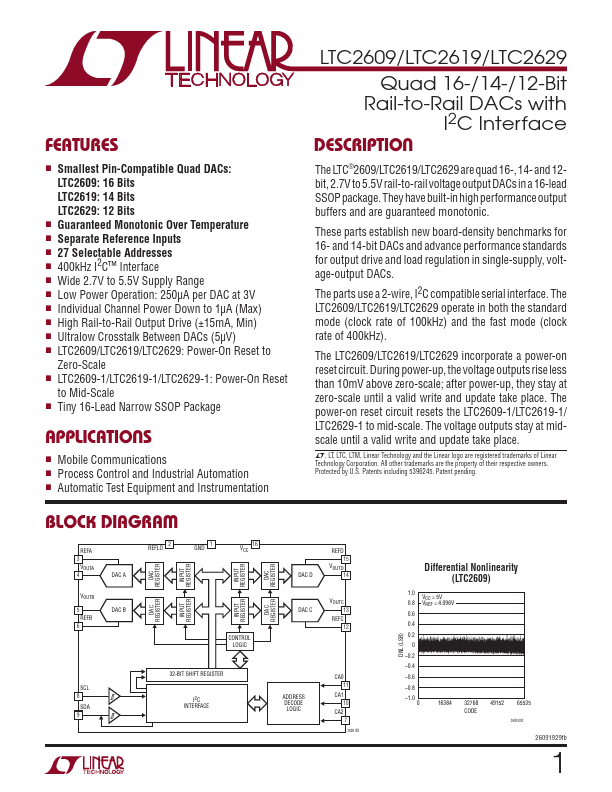
LTC2609
LTC2609 is Quad 16-/14-/12-Bit Rail-to-Rail DACs manufactured by Linear Technology.
- Part of the LTC2629 comparator family.
- Part of the LTC2629 comparator family.
Features n Smallest Pin-patible Quad DACs: LTC2609: 16 Bits LTC2619: 14 Bits LTC2629: 12 Bits n Guaranteed Monotonic Over Temperature n Separate Reference Inputs n 27 Selectable Addresses n 400k Hz I2C™ Interface n Wide 2.7V to 5.5V Supply Range n Low Power Operation: 250µA per DAC at 3V n Individual Channel Power Down to 1µA (Max) n High Rail-to-Rail Output Drive (±15m A, Min) n Ultralow Crosstalk Between DACs (5µV) n LTC2609/LTC2619/LTC2629: Power-On Reset to
Zero-Scale n LTC2609-1/LTC2619-1/LTC2629-1: Power-On Reset to Mid-Scale n Tiny 16-Lead Narrow SSOP Package
Applications n Mobile munications n Process Control and Industrial Automation n Automatic Test Equipment and Instrumentation
LTC2609/LTC2619/LTC2629 Quad 16-/14-/12-Bit
Rail-to-Rail DACs with I2C Interface
Description
The LTC®2609/LTC2619/LTC2629 are quad 16-, 14- and 12bit, 2.7V to 5.5V rail-to-rail voltage output DACs in a 16‑lead SSOP package. They have built-in high performance output buffers and are guaranteed monotonic. These parts establish new board-density benchmarks for 16- and 14-bit DACs and advance performance standards for output drive and load regulation in single-supply, voltage-output DACs. The parts use a 2-wire, I2C patible serial interface. The LTC2609/LTC2619/LTC2629 operate in both the standard mode (clock rate of 100k Hz) and the fast mode (clock rate of 400k Hz). The LTC2609/LTC2619/LTC2629 incorporate a power-on reset circuit. During power-up, the voltage outputs rise less than 10m V above zero-scale; after power-up, they stay at zero-scale until a valid write and update take place. The power-on reset circuit resets the LTC2609-1/LTC2619‑1/ LTC2629-1 to mid-scale. The voltage outputs stay at midscale until a valid write and update take place.
L, LT, LTC, LTM, Linear Technology and the Linear logo are registered trademarks of Linear Technology Corporation. All other trademarks are the property of their respective owners. Protected by U.S. Patents...