LTC3026
LTC3026 is 1.5A Low Input Voltage VLDO Linear Regulator manufactured by Linear Technology.
Features n Input Voltage Range: 1.14V to 3.5V (with Boost Enabled) 1.14V to 5.5V (with External 5V Boost) n Low Dropout Voltage: 100m V at IOUT = 1.5A n Adjustable Output Range: 0.4V to 2.6V n Output Current: Up to 1.5A n Excellent Supply Rejection Even Near Dropout n Shutdown Disconnects Load from VIN and VBST n Low Operating Current: IIN = 950µA at VIN = 1.5V n Low Shutdown Current:
IIN < 1µA (Typ), IBST = 0.1µA (Typ) n Stable with 10µF or Greater Ceramic Capacitors n Short-Circuit, Reverse Current Protected n Overtemperature Protected n Available in 10-Lead MSOP and 10-Lead
(3mm × 3mm) DFN Packages
Applications n High Efficiency Linear Regulator n Post Regulator for Switching Supplies n Microprocessor Supply
L, LT, LTC, LTM, Linear Technology, the Linear logo and Burst Mode are registered trademarks and Thin SOT, VLDO are trademarks of Linear Technology Corporation. All other trademarks are the property of their respective owners.
1.5A Low Input Voltage VLDO Linear Regulator
Description
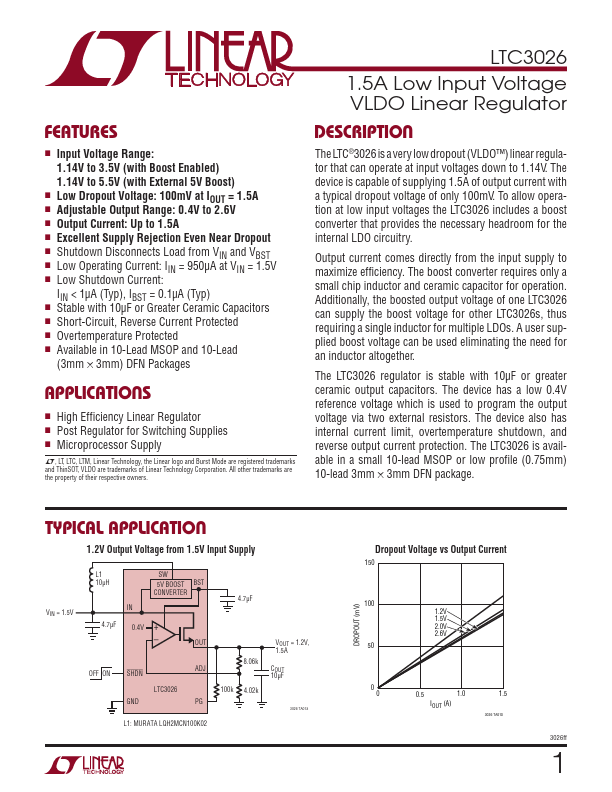
The LTC®3026 is a very low dropout (VLDO™) linear regulator that can operate at input voltages down to 1.14V. The device is capable of supplying 1.5A of output current with a typical dropout voltage of only 100m V. To allow operation at low input voltages the LTC3026 includes a boost converter that provides the necessary headroom for the internal LDO circuitry.
Output current es directly from the input supply to maximize efficiency. The boost converter requires only a small chip inductor and ceramic capacitor for operation. Additionally, the boosted output voltage of one LTC3026 can supply the boost voltage for other LTC3026s, thus requiring a single inductor for multiple LDOs. A user supplied boost voltage can be used eliminating the need for an inductor altogether.
The LTC3026 regulator is stable with 10µF or greater ceramic output capacitors. The device has a low 0.4V reference voltage which is used to program the output voltage via two external resistors. The device...