LTC3300-1
LTC3300-1 is High Efficiency Bidirectional Multicell Battery Balancer manufactured by Linear Technology.
Features n Bidirectional Synchronous Flyback Balancing of Up to 6 Li-Ion or Li Fe PO4 Cells in Series n Up to 10A Balancing Current (Set by Externals) n Integrates Seamlessly with the LTC680x Family of
Multicell Battery Stack Monitors n Bidirectional Architecture Minimizes Balancing
Time and Power Dissipation n Up to 92% Charge Transfer Efficiency n Stackable Architecture Enables >1000V Systems n Uses Simple 2-Winding Transformers n 1MHz Daisy-Chainable Serial Interface with 4-Bit
CRC Packet Error Checking n High Noise Margin Serial munication n Numerous Fault Protection Features n 48-Lead Exposed Pad QFN and LQFP Packages n AEC-Q100 Qualified for Automotive Applications
APPLICATIONS n Electric Vehicles/Plug-in HEVs n High Power UPS/Grid Energy Storage Systems n General Purpose Multicell Battery Stacks
LTC3300-1 High Efficiency Bidirectional
Multicell Battery Balancer
DESCRIPTION
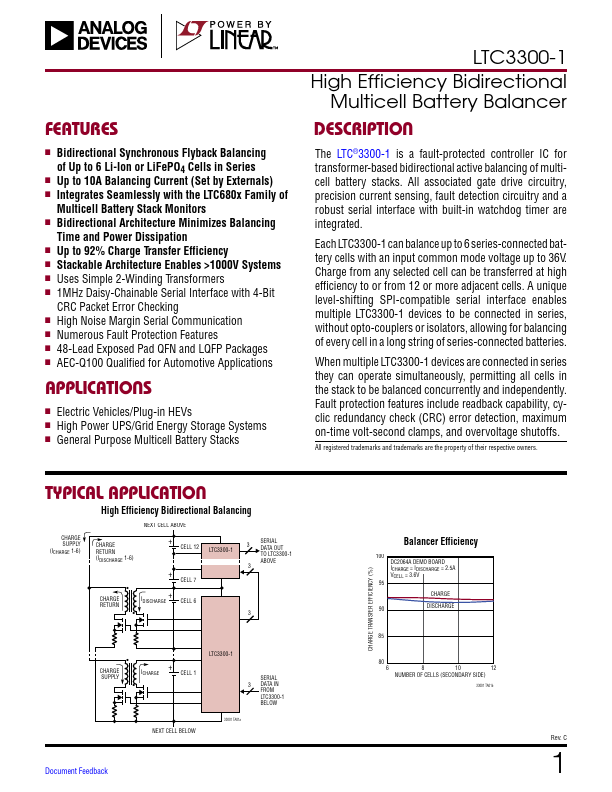
The LTC®3300-1 is a fault-protected controller IC for transformer-based bidirectional active balancing of multicell battery stacks. All associated gate drive circuitry, precision current sensing, fault detection circuitry and a robust serial interface with built-in watchdog timer are integrated. Each LTC3300-1 can balance up to 6 series-connected battery cells with an input mon mode voltage up to 36V. Charge from any selected cell can be transferred at high efficiency to or from 12 or more adjacent cells. A unique level-shifting SPI-patible serial interface enables multiple LTC3300-1 devices to be connected in series, without opto-couplers or isolators, allowing for balancing of every cell in a long string of series-connected batteries. When multiple LTC3300-1 devices are connected in series they can operate simultaneously, permitting all cells in the stack to be balanced concurrently and independently. Fault protection Features include readback capability, cyclic redundancy check (CRC) error detection, maximum on-time volt-second clamps, and overvoltage...