LTC3619B
LTC3619B is 400mA/800mA Synchronous Step-Down DC/DC manufactured by Linear Technology.
400m A/800m A Synchronous
Step-Down DC/DC with
Average Input Current Limit
Features
Description n Programmable Average Input Current Limit: ±5% Accuracy n Dual Step-Down Outputs: Up to 96% Efficiency n Low Noise Pulse-Skipping Operation at Light Loads n Input Voltage Range: 2.5V to 5.5V n Output Voltage Range: 0.6V to 5V n 2.25MHz Constant-Frequency Operation n Power Good Output Voltage Monitor for Each Channel n Low Dropout Operation: 100% Duty Cycle n Independent Internal Soft-Start for Each Channel n Current Mode Operation for Excellent Line and Load
Transient Response n ±2% Output Voltage Accuracy n Short-Circuit Protected n Shutdown Current ≤ 1μA n Available in Small Thermally Enhanced 10-Lead MS and 3mm × 3mm DFN Packages
Applications n High Peak Load Current Applications n USB Powered Devices n Supercapacitor Charging n Radio Transmitters and Other Handheld Devices
L, LT, LTC, LTM, Linear Technology, the Linear logo and Burst Mode are registered trademarks and Hot Swap is a trademark of Linear Technology Corporation. All other trademarks are the property of their respective owners. Protected by U.S. Patents, including 5481178, 6127815, 6304066, 6498466, 6580258, 6611131.
The LTC®3619B is a dual monolithic synchronous buck regulator using a constant frequency current mode architecture.
The input supply voltage range is 2.5V to 5.5V, making it ideal for Li-Ion and USB powered applications. 100% duty cycle capability provides low dropout operation, extending the run time in battery-operated systems. Low output voltages are supported with the 0.6V feedback reference voltage. Channel 1 and channel 2 can supply 400m A and 800m A output current, respectively.
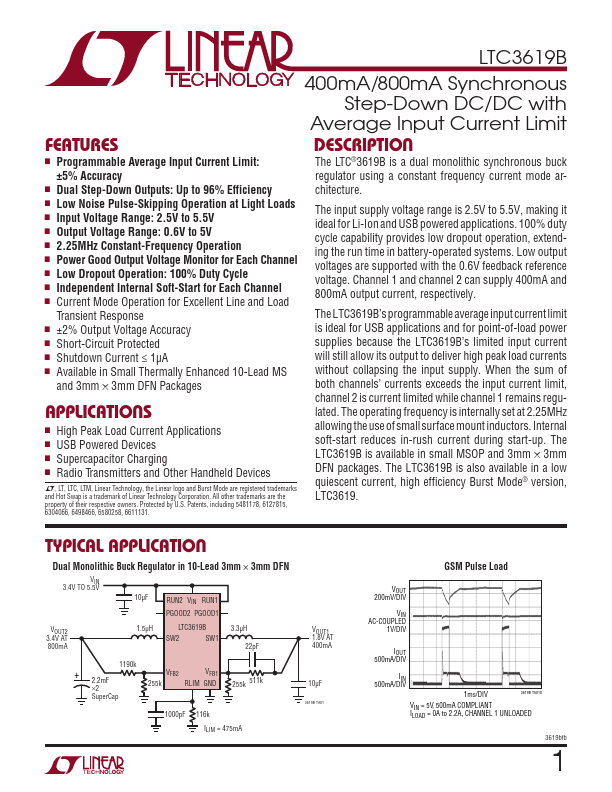
The LTC3619B’s programmable average input current limit is ideal for USB applications and for point-of-load power supplies because the LTC3619B’s limited input current will still allow its output to deliver high peak load currents without collapsing the input supply. When the sum of both channels’...