LTC4101
LTC4101 is Smart Battery Charger Controller manufactured by Linear Technology.
Features n Single Chip Smart Battery Charger Controller n 100% pliant (Rev. 1.1) SMBus Support Allows for Operation with or without Host n Up to 4A Charging Current Capability n High Efficiency Synchronous Buck Charger n VBAT Optimized 3V to 5.5V n SMBus Accelerator Improves SMBus Timing n Hardware Interrupt and SMBAlert Response
Eliminate Interrupt Polling n 0.5V Dropout Voltage; Maximum Duty Cycle > 98% n AC Adapter Current Limit Maximizes Charge Rate n ±0.8% Voltage Accuracy; ±4% Current Accuracy n 10-Bit DAC for Charge Current Programming n 11-Bit DAC for Charger Voltage Programming n User-Selectable Overvoltage and Overcurrent Limits n High Noise Immunity Safety Signal Sensor n Available in a 24-Pin SSOP Package
APPLICATIONS n Portable Instruments and puters n Data Storage Systems and Battery Backup Servers
L, LT, LTC, LTM, Linear Technology and the Linear logo are registered trademarks of Linear Technology Corporation. All other trademarks are the property of their respective owners. Protected by U.S. Patents including 6650174, 5723970.
Smart Battery Charger Controller DESCRIPTION
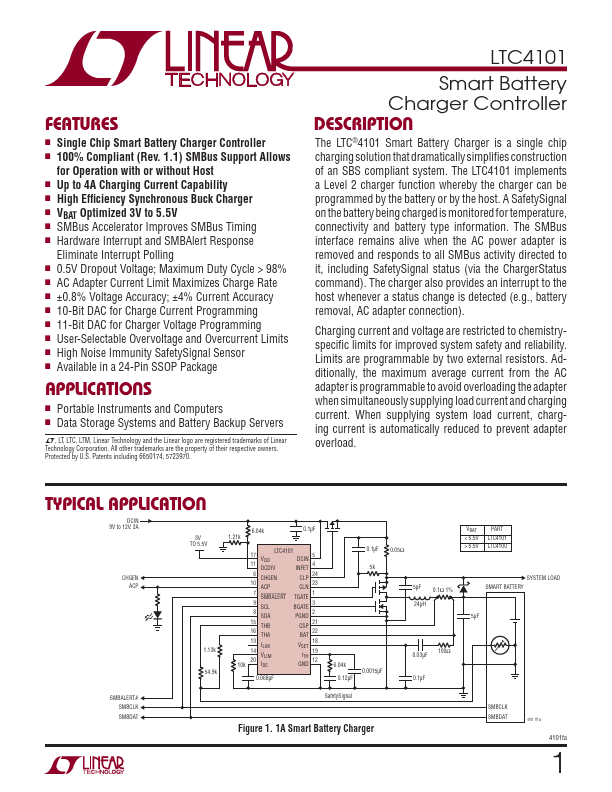
The LTC®4101 Smart Battery Charger is a single chip charging solution that dramatically simplifies construction of an SBS pliant system. The LTC4101 implements a Level 2 charger function whereby the charger can be programmed by the battery or by the host. A Safety Signal on the battery being charged is monitored for temperature, connectivity and battery type information. The SMBus interface remains alive when the AC power adapter is removed and responds to all SMBus activity directed to it, including Safety Signal status (via the Charger Status mand). The charger also provides an interrupt to the host whenever a status change is detected (e.g., battery removal, AC adapter connection).
Charging current and voltage are restricted to chemistryspecific limits for improved system safety and reliability. Limits are programmable by two external resistors. Additionally, the...