LTC4413-1
LTC4413-1 is Fast Ideal Diodes manufactured by Linear Technology.
Features n 2-Channel Ideal Diode OR’ing or Load Sharing n Low Loss Replacement for Power Path™ OR’ing
Diodes n Fast Response Replacement for LTC4413 n Low Forward On-Resistance (140mΩ Max at 3.6V) n Low Reverse Leakage Current n Low Regulated Forward Voltage (18m V Typ) n Overvoltage Protection Sensor with Drive Output for an External P-Channel MOSFET (LTC4413-2 Only) n 2.5V to 5.5V Operating Range n 2.6A Maximum Forward Current n Internal Current Limit Protection n Internal Thermal Protection n Status Output to Indicate if Selected Channel is
Conducting n Programmable Channel On/Off n Low Profile (0.75mm) 10-Lead 3mm × 3mm DFN
Package
Applications n Battery and Wall Adapter Diode OR’ing in Handheld Products n Backup Battery Diode OR’ing n Power Switching n USB Peripherals n Uninterruptable Supplies
LTC4413-1/LTC4413-2
Dual 2.6A, 2.5V to 5.5V Fast Ideal Diodes in 3mm × 3mm DFN Description
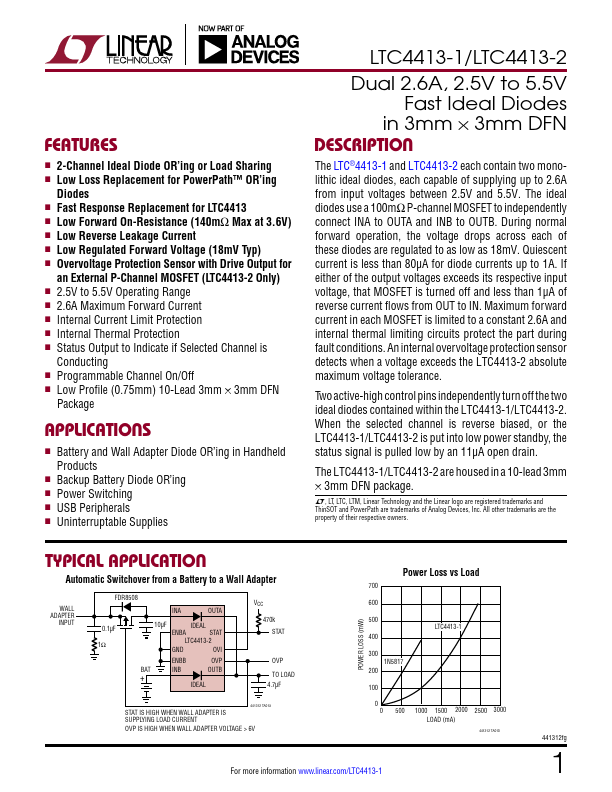
The LTC®4413-1 and LTC4413-2 each contain two monolithic ideal diodes, each capable of supplying up to 2.6A from input voltages between 2.5V and 5.5V. The ideal diodes use a 100mΩ P-channel MOSFET to independently connect INA to OUTA and INB to OUTB. During normal forward operation, the voltage drops across each of these diodes are regulated to as low as 18m V. Quiescent current is less than 80µA for diode currents up to 1A. If either of the output voltages exceeds its respective input voltage, that MOSFET is turned off and less than 1µA of reverse current flows from OUT to IN. Maximum forward current in each MOSFET is limited to a constant 2.6A and internal thermal limiting circuits protect the part during fault conditions. An internal overvoltage protection sensor detects when a voltage exceeds the LTC4413-2 absolute maximum voltage tolerance.
Two active-high control pins independently turn off the two ideal diodes contained within the LTC4413-1/LTC4413‑2. When the selected channel is reverse biased, or the LTC4413-1/LTC4413-2 is put into low power standby, the status signal is...