LTC6905
LTC6905 is 17MHz to 170MHz Resistor Set SOT-23 Oscillator manufactured by Linear Technology.
Features n One External Resistor Sets the Frequency n Fast Start-Up Time: 100μs Typical n Frequency Range: 17MHz to 170MHz n Frequency Error ±0.5% Typ 17MHz to 170MHz
(TA = 0°C to 70°C, Over All Settings) n ±20ppm/°C Temperature Stability n Rise Time: 0.5ns, CL = 5p F n Timing Jitter: 7.2ps RMS at 170MHz n 50% ±2.5% Duty Cycle n 6m A Typical Supply Current, f OSC = 100MHz n CMOS Output Drives 500Ω Load (VS = 3V) n Operates from a Single 2.7V to 5.5V Supply n Low Profile (1mm) Thin SOT™ Package
APPLICATIONS n High Frequency Precision Oscillator n High Speed Data Bus Clock n Fixed Crystal Oscillator Replacement n Ceramic Oscillator Replacement
L, LT, LTC and LTM are registered trademarks of Linear Technology Corporation. Thin SOT is a trademark of Linear Technology Corporation. All other trademarks are the property of their respective owners. Protected by U.S. Patents including 6614313, 6342817.
17MHz to 170MHz Resistor Set SOT-23 Oscillator
DESCRIPTION
The LTC®6905 precision, programmable silicon oscillator is easy to use and occupies very little board space. It requires only a single resistor to set the output frequency from 17MHz to 170MHz with a typical frequency error of 0.5% or less.
The LTC6905 operates with a single 2.7V to 5.5V power supply and provides a rail-to-rail, 50% duty cycle square wave output. The CMOS output driver ensures fast rise/fall times and rail-to-rail switching. Operation is simple: A single resistor, RSET, between 10k to 25k is used to set the frequency, and an internal three-state divider (DIV input) allows for division of the master clock by 1, 2 or 4, providing three frequencies for each RSET value.
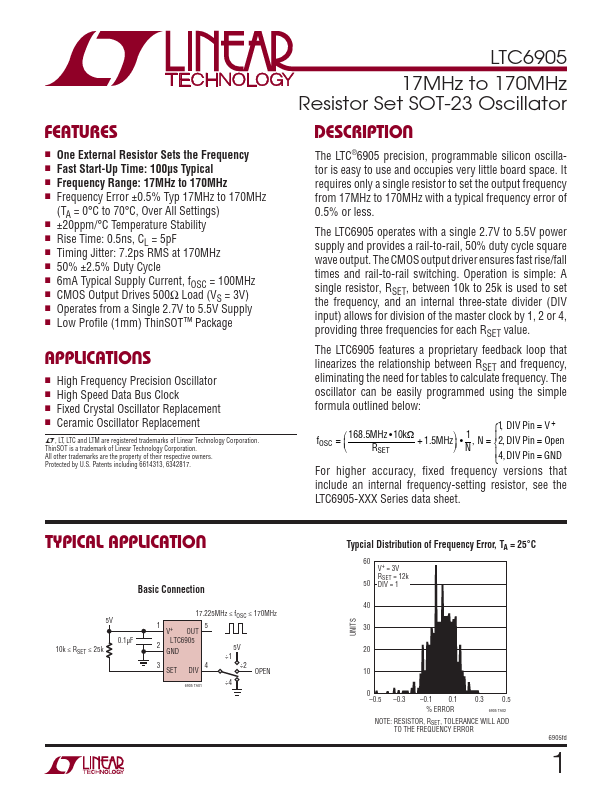
The LTC6905 Features a proprietary feedback loop that linearizes the relationship between RSET and frequency, eliminating the need for tables to calculate frequency. The oscillator can be easily programmed using the simple formula outlined below:
⎧1, DIV Pin = V + f OSC
=
⎛ 168.5MHz
- 10kΩ ⎝⎜ RSET
+
1.5MHz⎞⎠⎟
- 1,...