LTC5583
LTC5583 is Matched Dual-Channel 6GHz RMS Power Detector manufactured by Linear Technology.
Features n Frequency Range: 40MHz to 6GHz n Linear Dynamic Range: Up to 60d B n ±0.5d B (Typ) Accuracy Over Temperature n 40d B Channel-to-Channel Isolation at 2GHz Even with Single-Ended RF Inputs n Matched Dual-Channel Outputs: <1.25d B (Typ) n Single-Ended RF Inputs- No Transformer Required n Accurate RMS Power Measurement of High Crest
Factor Modulated Waveforms n Difference Output Provides VSWR Measurement n Fast Envelope Detector Outputs n Fast Response Time: 140ns Rise Time n Small 4mm × 4mm QFN24 Package
APPLICATIONS n VSWR Monitor n MIMO Transmit Power Control n Basestation PA Control n Transmit and Receive Gain Control n RF Instrumentation
L, LT, LTC, LTM, Linear Technology and the Linear logo are registered trademarks of Linear Technology Corporation. All other trademarks are the property of their respective owners. Protected by U.S. Patents including 7262661, 7317357, 7622981.
Matched Dual-Channel 6GHz RMS Power Detector
DESCRIPTION
The LTC®5583 is a dual-channel RMS power detector, capable of measuring two AC signals with wide dynamic range, from
- 59d Bm to 4d Bm, depending on frequency. Each AC signal’s power in decibel-scaled value is precisely converted to a DC voltage on a linear scale, independent of the crest factor of the input signal waveforms. The LTC5583 is suitable for precision power measurement and level control for a variety of RF standards, including LTE, EDGE, W-CDMA, CDMA2000, TD-SCDMA, and Wi MAX.
Good channel-to-channel isolation is necessary for operating the dual channels simultaneously. For applications where the two input signals are at the same frequency (e.g. measuring VSWR), the LTC5583 provides 40d B isolation at 2.14GHz even with single-ended inputs. No baluns are needed. When the two input signals are at different frequencies, the isolation can be as high as 50d B. The isolation can be improved to >55d B with differential inputs.
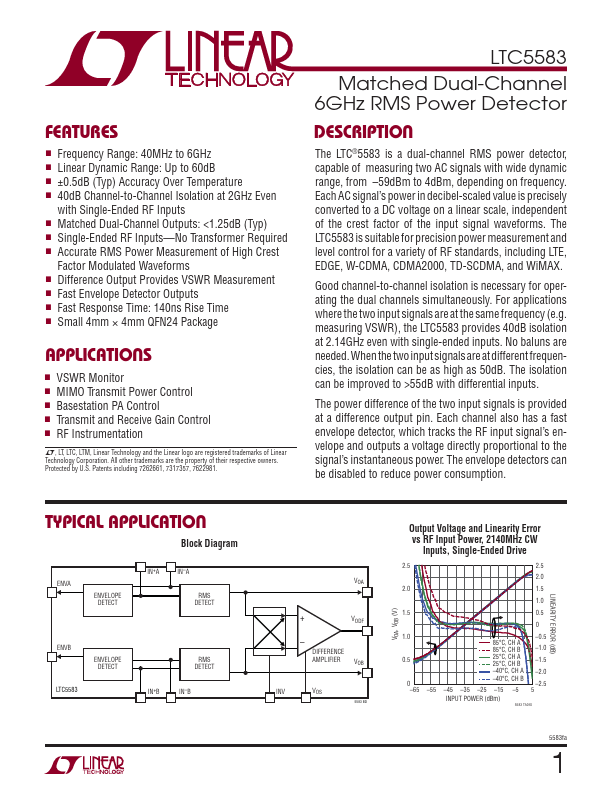
The power difference of the two input signals is provided at a difference output pin. Each...