Datasheet4U Logo Datasheet4U.com

XR1008-QB - Receiver

Download the XR1008-QB datasheet PDF. This datasheet also covers the XR1008-QB-MA variant, as both devices belong to the same receiver family and are provided as variant models within a single manufacturer datasheet.

General Description

The XR1008-QB is a 35.0-45.0 GHz packaged receiver that has a noise figure of 3.5 dB and 5.0 dBm Input Third Order Intercept across the band.

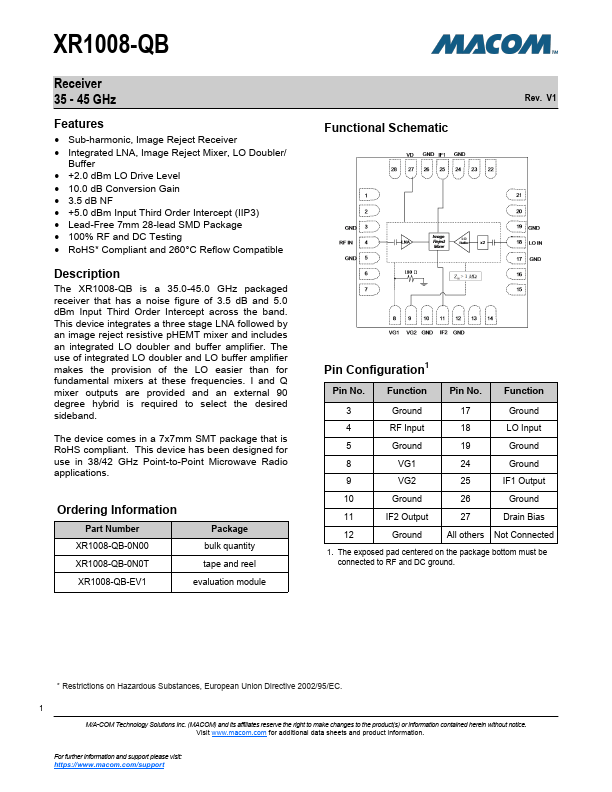
This device integrates a three stage LNA followed by an image reject resistive pHEMT mixer and includes an integrated LO doubler and buffer amplifier.

Key Features

  • Sub-harmonic, Image Reject Receiver.
  • Integrated LNA, Image Reject Mixer, LO Doubler/ Buffer.
  • +2.0 dBm LO Drive Level.
  • 10.0 dB Conversion Gain.
  • 3.5 dB NF.
  • +5.0 dBm Input Third Order Intercept (IIP3).
  • Lead-Free 7mm 28-lead SMD Package.
  • 100% RF and DC Testing.
  • RoHS.
  • Compliant and 260°C Reflow Compatible.

📥 Download Datasheet

Note: The manufacturer provides a single datasheet file (XR1008-QB-MA-COM.pdf) that lists specifications for multiple related part numbers.

Full PDF Text Transcription (Reference)

The following content is an automatically extracted verbatim text from the original manufacturer datasheet and is provided for reference purposes only.

View original datasheet text
XR1008-QB Receiver 35 - 45 GHz Features  Sub-harmonic, Image Reject Receiver  Integrated LNA, Image Reject Mixer, LO Doubler/ Buffer  +2.0 dBm LO Drive Level  10.0 dB Conversion Gain  3.5 dB NF  +5.0 dBm Input Third Order Intercept (IIP3)  Lead-Free 7mm 28-lead SMD Package  100% RF and DC Testing  RoHS* Compliant and 260°C Reflow Compatible Description The XR1008-QB is a 35.0-45.0 GHz packaged receiver that has a noise figure of 3.5 dB and 5.0 dBm Input Third Order Intercept across the band. This device integrates a three stage LNA followed by an image reject resistive pHEMT mixer and includes an integrated LO doubler and buffer amplifier. The use of integrated LO doubler and LO buffer amplifier makes the provision of the LO easier than for fundamental mixers at these frequencies.