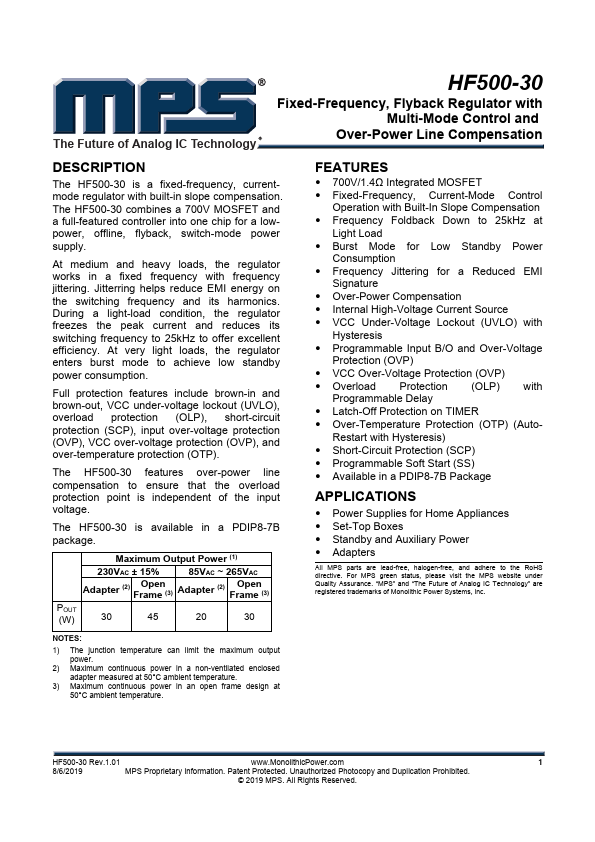
HF500GP-30
HF500GP-30 is Flyback Regulator manufactured by Monolithic Power Systems.
- Part of the HF500-30 comparator family.
- Part of the HF500-30 comparator family.
The Future of Analog IC Technology
HF500-30
Fixed-Frequency, Flyback Regulator with Multi-Mode Control and
Over-Power Line pensation
DESCRIPTION
The HF500-30 is a fixed-frequency, currentmode regulator with built-in slope pensation. The HF500-30 bines a 700V MOSFET and a full-featured controller into one chip for a lowpower, offline, flyback, switch-mode power supply.
At medium and heavy loads, the regulator works in a fixed frequency with frequency jittering. Jitterring helps reduce EMI energy on the switching frequency and its harmonics. During a light-load condition, the regulator freezes the peak current and reduces its switching frequency to 25k Hz to offer excellent efficiency. At very light loads, the regulator enters burst mode to achieve low standby power consumption.
Full protection Features include brown-in and brown-out, VCC under-voltage lockout (UVLO), overload protection (OLP), short-circuit protection (SCP), input over-voltage protection (OVP), VCC over-voltage protection (OVP), and over-temperature protection (OTP).
The HF500-30 Features over-power line pensation to ensure that the overload protection point is independent of the input voltage.
The HF500-30 is available in a PDIP8-7B package.
Maximum Output Power (1)
230VAC ± 15%
85VAC ~ 265VAC
Adapter
(2)
Open Frame (3)
Adapter (2)
Open Frame (3)
POUT (W)
Features
- 700V/1.4Ω Integrated MOSFET
- Fixed-Frequency, Current-Mode Control
Operation with Built-In Slope pensation
- Frequency Foldback Down to 25k Hz at
Light Load
- Burst Mode for Low Standby Power
Consumption
- Frequency Jittering for a Reduced EMI
Signature
- Over-Power...