Datasheet4U Logo Datasheet4U.com

MP26057DQ - 1A Linear Li-lon Travel Charger

This page provides the datasheet information for the MP26057DQ, a member of the MP26057 1A Linear Li-lon Travel Charger family.

Datasheet Summary

Description

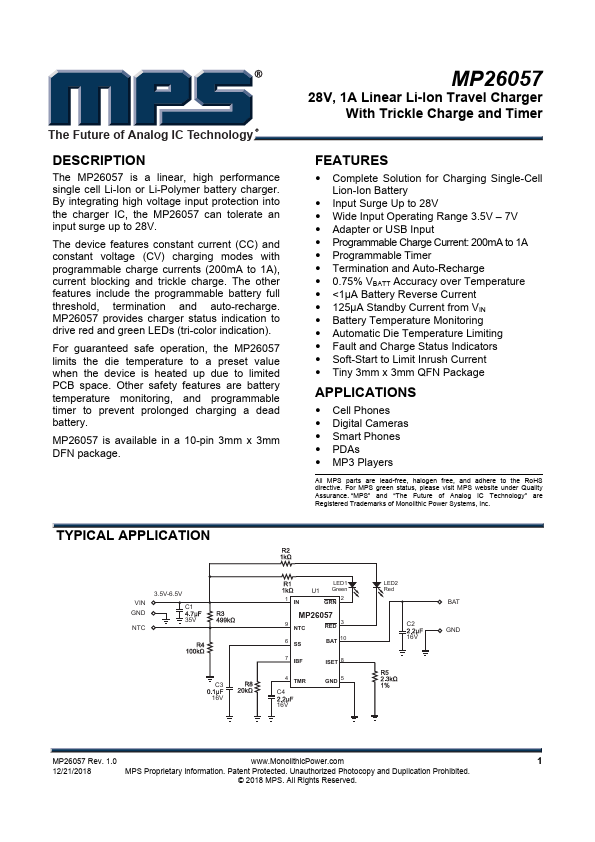
The MP26057 is a linear, high performance single cell Li-Ion or Li-Polymer battery charger.

By integrating high voltage input protection into the charger IC, the MP26057 can tolerate an input surge up to 28V.

Features

  • constant current (CC) and constant voltage (CV) charging modes with programmable charge currents (200mA to 1A), current blocking and trickle charge. The other features include the programmable battery full threshold, termination and auto-recharge. MP26057 provides charger status indication to drive red and green LEDs (tri-color indication). For guaranteed safe operation, the MP26057 limits the die temperature to a preset value when the device is heated up due to limited PCB space. Other safety f.

📥 Download Datasheet

Datasheet preview – MP26057DQ

Datasheet Details

Part number MP26057DQ
Manufacturer MPS
File Size 415.13 KB
Description 1A Linear Li-lon Travel Charger
Datasheet download datasheet MP26057DQ Datasheet
Additional preview pages of the MP26057DQ datasheet.
Other Datasheets by MPS

Full PDF Text Transcription

Click to expand full text
The Future of Analog IC Technology DESCRIPTION The MP26057 is a linear, high performance single cell Li-Ion or Li-Polymer battery charger. By integrating high voltage input protection into the charger IC, the MP26057 can tolerate an input surge up to 28V. The device features constant current (CC) and constant voltage (CV) charging modes with programmable charge currents (200mA to 1A), current blocking and trickle charge. The other features include the programmable battery full threshold, termination and auto-recharge. MP26057 provides charger status indication to drive red and green LEDs (tri-color indication). For guaranteed safe operation, the MP26057 limits the die temperature to a preset value when the device is heated up due to limited PCB space.
Published: |