Datasheet4U Logo Datasheet4U.com

MPQ3362GJ-AEC1 - Boost LED Driver

Download the MPQ3362GJ-AEC1 datasheet PDF. This datasheet also covers the MPQ3362 variant, as both devices belong to the same boost led driver family and are provided as variant models within a single manufacturer datasheet.

General Description

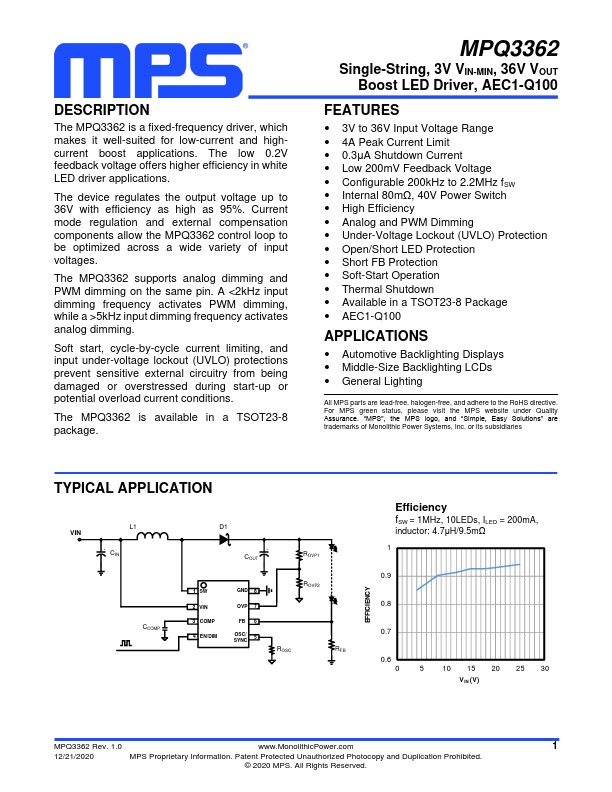
The MPQ3362 is a fixed-frequency driver, which makes it well-suited for low-current and highcurrent boost applications.

The low 0.2V feedback voltage offers higher efficiency in white LED driver applications.

The device regulates the output voltage up to 36V with efficiency as high as 95%.

Key Features

  • 3V to 36V Input Voltage Range.
  • 4A Peak Current Limit.
  • 0.3μA Shutdown Current.
  • Low 200mV Feedback Voltage.
  • Configurable 200kHz to 2.2MHz fSW.
  • Internal 80mΩ, 40V Power Switch.
  • High Efficiency.
  • Analog and PWM Dimming.
  • Under-Voltage Lockout (UVLO) Protection.
  • Open/Short LED Protection.
  • Short FB Protection.
  • Soft-Start Operation.
  • Thermal Shutdown.
  • Available in a TSOT23-8 Package.
  • AEC1-Q100.

📥 Download Datasheet

Note: The manufacturer provides a single datasheet file (MPQ3362-MPS.pdf) that lists specifications for multiple related part numbers.

Full PDF Text Transcription (Reference)

The following content is an automatically extracted verbatim text from the original manufacturer datasheet and is provided for reference purposes only.

View original datasheet text
DESCRIPTION The MPQ3362 is a fixed-frequency driver, which makes it well-suited for low-current and highcurrent boost applications. The low 0.2V feedback voltage offers higher efficiency in white LED driver applications. The device regulates the output voltage up to 36V with efficiency as high as 95%. Current mode regulation and external compensation components allow the MPQ3362 control loop to be optimized across a wide variety of input voltages. The MPQ3362 supports analog dimming and PWM dimming on the same pin. A <2kHz input dimming frequency activates PWM dimming, while a >5kHz input dimming frequency activates analog dimming.