Datasheet4U Logo Datasheet4U.com

MPQ3369GF-AEC1 - Boost WLED Driver

This page provides the datasheet information for the MPQ3369GF-AEC1, a member of the MPQ3369-AEC1 Boost WLED Driver family.

Datasheet Summary

Description

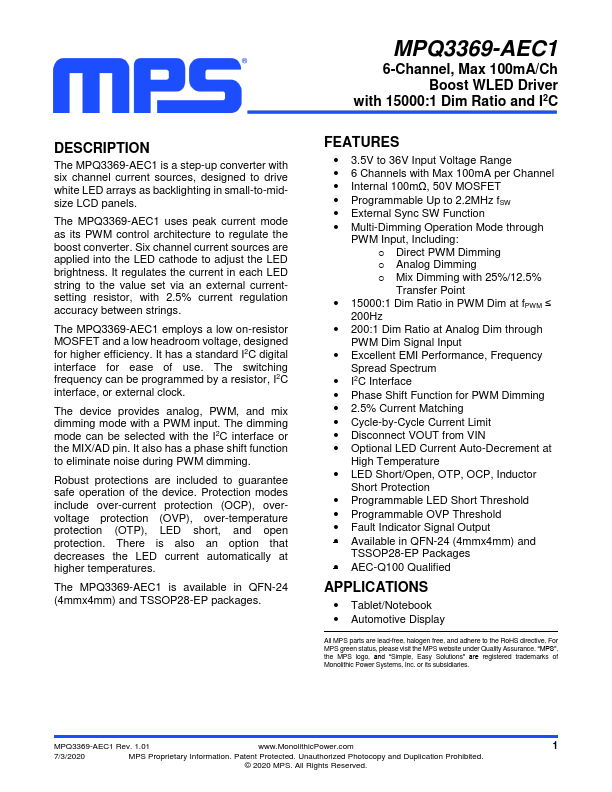
The MPQ3369-AEC1 is a step-up converter with six channel current sources, designed to drive white LED arrays as backlighting in small-to-midsize LCD panels.

The MPQ3369-AEC1 uses peak current mode as its PWM control architecture to regulate the boost converter.

Features

  • 3.5V to 36V Input Voltage Range.
  • 6 Channels with Max 100mA per Channel.
  • Internal 100mΩ, 50V MOSFET.
  • Programmable Up to 2.2MHz fSW.
  • External Sync SW Function.
  • Multi-Dimming Operation Mode through PWM Input, Including: o Direct PWM Dimming o Analog Dimming o Mix Dimming with 25%/12.5% Transfer Point.
  • 15000:1 Dim Ratio in PWM Dim at fPWM ≤ 200Hz.
  • 200:1 Dim Ratio at Analog Dim through PWM Dim Signal Input.
  • Excellent EMI Performance, Frequency Spread Spec.

📥 Download Datasheet

Datasheet preview – MPQ3369GF-AEC1

Datasheet Details

Part number MPQ3369GF-AEC1
Manufacturer MPS
File Size 1.21 MB
Description Boost WLED Driver
Datasheet download datasheet MPQ3369GF-AEC1 Datasheet
Additional preview pages of the MPQ3369GF-AEC1 datasheet.
Other Datasheets by MPS

Full PDF Text Transcription

Click to expand full text
DESCRIPTION The MPQ3369-AEC1 is a step-up converter with six channel current sources, designed to drive white LED arrays as backlighting in small-to-midsize LCD panels. The MPQ3369-AEC1 uses peak current mode as its PWM control architecture to regulate the boost converter. Six channel current sources are applied into the LED cathode to adjust the LED brightness. It regulates the current in each LED string to the value set via an external currentsetting resistor, with 2.5% current regulation accuracy between strings. The MPQ3369-AEC1 employs a low on-resistor MOSFET and a low headroom voltage, designed for higher efficiency. It has a standard I2C digital interface for ease of use. The switching frequency can be programmed by a resistor, I2C interface, or external clock.
Published: |