• Part: SP508E
  • Description: 8-Channel Multi-Protocol Transceiver
  • Manufacturer: MaxLinear
  • Size: 670.41 KB
Download SP508E Datasheet PDF
MaxLinear
SP508E
SP508E is 8-Channel Multi-Protocol Transceiver manufactured by MaxLinear.
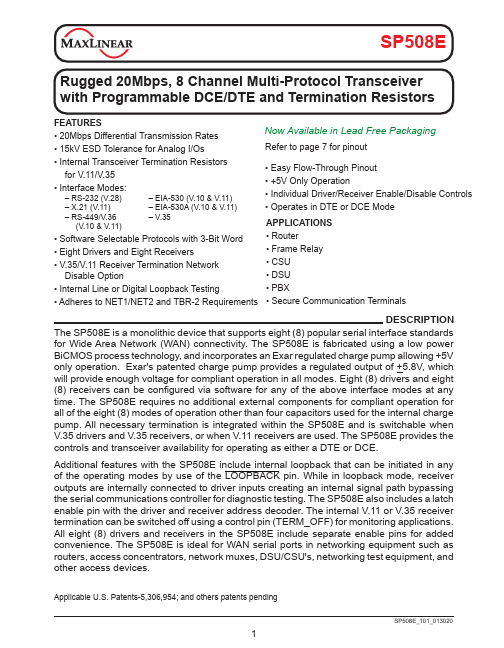
FEATURES - 20Mbps Differential Transmission Rates - 15k V ESD Tolerance for Analog I/Os Now Available in Lead Free Packaging Refer to page 7 for pinout - Internal Transceiver Termination Resistors for V.11/V.35 - Interface Modes: - RS-232 (V.28) - X.21 (V.11) - RS-449/V.36 (V.10 & V.11) - EIA-530 (V.10 & V.11) - EIA-530A (V.10 & V.11) - V.35 - Software Selectable Protocols with 3-Bit Word - Eight Drivers and Eight Receivers - V.35/V.11 Receiver Termination Network Disable Option - Easy Flow-Through Pinout - +5V Only Operation - Individual Driver/Receiver Enable/Disable Controls - Operates in DTE or DCE Mode APPLICATIONS - Router - Frame Relay - CSU - DSU - Internal Line or Digital Loopback Testing - PBX - Adheres to NET1/NET2 and TBR-2 Requirements - Secure munication Terminals DESCRIPTION The SP508E is a monolithic device that supports eight (8) popular serial interface standards for Wide Area Network (WAN) connectivity. The SP508E is fabricated using a low power Bi CMOS process technology, and incorporates an Exar regulated charge pump allowing +5V only operation. Exar's patented charge pump provides a regulated output of +5.8V, which will provide enough voltage for pliant operation in all modes. Eight (8) drivers and eight (8) receivers can be configured via software for any of the above interface modes at any time. The SP508E requires no additional external ponents for pliant operation for all of the eight (8) modes of operation other than four capacitors used for the internal charge pump. All necessary termination is integrated within the SP508E and is switchable when V.35 drivers and V.35 receivers, or when V.11 receivers are used. The SP508E provides the controls and transceiver availability for operating as either a DTE or DCE. Additional features with the SP508E include internal loopback that can be initiated in any of the operating modes by use of the LOOPBACK pin. While in loopback mode, receiver outputs are internally connected to...