MAX13342E
MAX13342E is 3-Wire Interface Full Speed USB Transceivers manufactured by Maxim Integrated.
Description
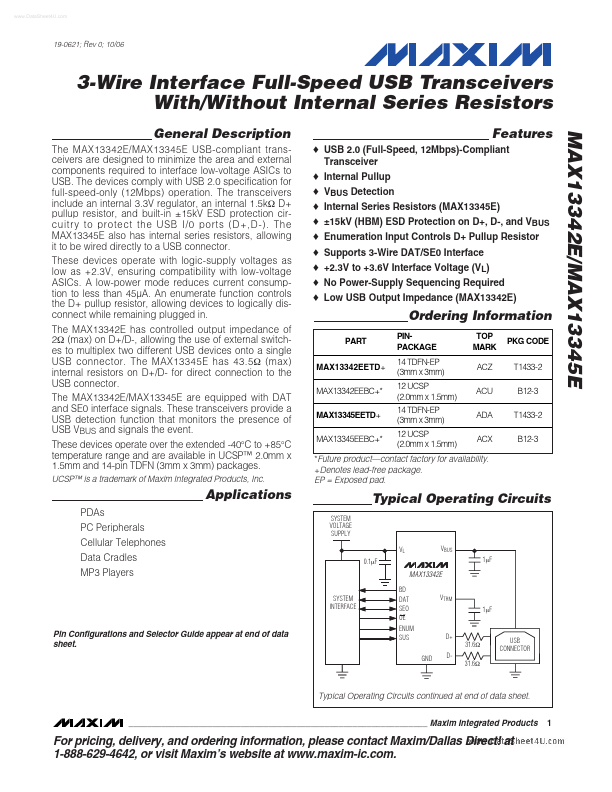
The MAX13342E/MAX13345E USB-pliant transceivers are designed to minimize the area and external ponents required to interface low-voltage ASICs to USB. The devices ply with USB 2.0 specification for full-speed-only (12Mbps) operation. The transceivers include an internal 3.3V regulator, an internal 1.5kΩ D+ pullup resistor, and built-in ±15k V ESD protection circuitry to protect the USB I/0 ports (D+,D-). The MAX13345E also has internal series resistors, allowing it to be wired directly to a USB connector. These devices operate with logic-supply voltages as low as +2.3V, ensuring patibility with low-voltage ASICs. A low-power mode reduces current consumption to less than 45µA. An enumerate function controls the D+ pullup resistor, allowing devices to logically disconnect while remaining plugged in. The MAX13342E has controlled output impedance of 2Ω (max) on D+/D-, allowing the use of external switches to multiplex two different USB devices onto a single USB connector. The MAX13345E has 43.5Ω (max) internal resistors on D+/D- for direct connection to the USB connector. The MAX13342E/MAX13345E are equipped with DAT and SE0 interface signals. These transceivers provide a USB detection function that monitors the presence of USB VBUS and signals the event. These devices operate over the extended -40°C to +85°C temperature range and are available in UCSP™ 2.0mm x 1.5mm and 14-pin TDFN (3mm x 3mm) packages.
UCSP™ is a trademark of Maxim Integrated Products, Inc.
Features o USB 2.0 (Full-Speed, 12Mbps)-pliant Transceiver o Internal Pullup o VBUS Detection o Internal Series Resistors (MAX13345E) o ±15k V (HBM) ESD Protection on D+, D-, and VBUS o Enumeration Input Controls D+ Pullup Resistor o Supports 3-Wire DAT/SE0 Interface o +2.3V to +3.6V Interface Voltage (VL) o No Power-Supply Sequencing Required o Low USB Output Impedance (MAX13342E)
MAX13342E/MAX13345E
Ordering Information
PART MAX13342EETD+ MAX13342EEBC+- MAX13345EETD+ MAX13345EEBC+- PINPACKAGE 14...