MAX4208
MAX4208 is Precision Instrumentation Amplifiers manufactured by Maxim Integrated.
..
19-0924; Rev 0; 9/07
KIT ATION EVALU LE B A IL A AV
Ultra-Low Offset/Drift, Precision Instrumentation Amplifiers with REF Buffer
General Description Features
- Ultra-Low Input Offset Voltage ±20µV (max) at +25°C
- ±0.25% (max) Gain Error
- Low 0.2µV/°C Offset Voltage Drift
- 1p A CMOS Input Bias Current
- True Ground Sensing with Rail-to-Rail Output
- Buffered REF Input for High Accuracy and Bipolar Operation
- 2.85V to 5.5V Single-Supply Operation (or ±1.425V to ±2.75V Dual Supplies)
- 750µA Supply Current
- 1.4µA Shutdown Mode
- 750k Hz Gain-Bandwidth Product
- Operate Over the -40°C to +125°C Automotive Temperature Range
- Tiny 8-Pin µMAX Package
MAX4208/MAX4209
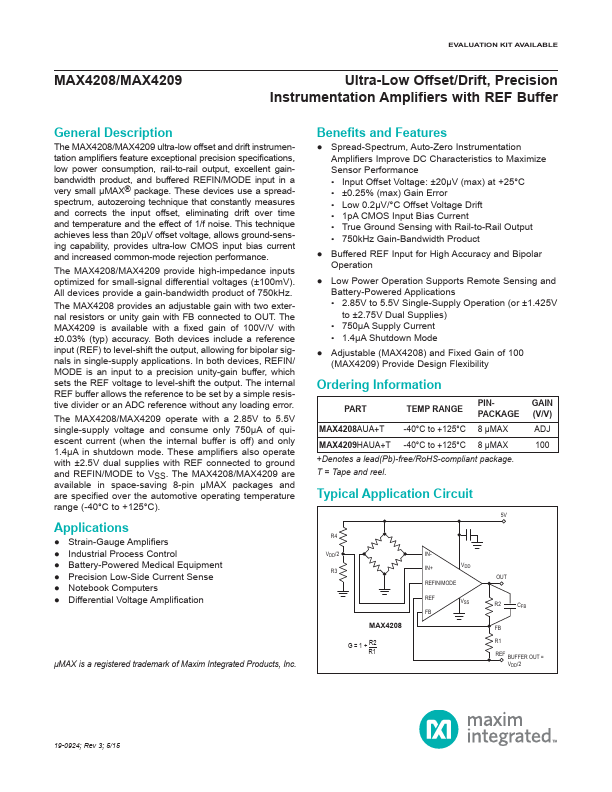
The MAX4208/MAX4209 ultra-low offset and drift instrumentation amplifiers feature exceptional precision specifications, low power consumption, rail-to-rail output, excellent gain-bandwidth product, and buffered REFIN/MODE input in a very small µMAX® package. These devices use a patented † spread-spectrum, autozeroing technique that constantly measures and corrects the input offset, eliminating drift over time and temperature and the effect of 1/f noise. This technique achieves less than 20µV offset voltage, allows groundsensing capability, provides ultra-low CMOS input bias current and increased mon-mode rejection performance. The MAX4208/MAX4209 provide high-impedance inputs optimized for small-signal differential voltages (±100m V). All devices provide a gain-bandwidth product of 750k Hz. The MAX4208 provides an adjustable gain with two external resistors or unity gain with FB connected to OUT. The MAX4209 is available in fixed gains of 10V/V, 100V/V, or 1000V/V (suffixed T, H, and K) with ±0.03% (typ) accuracy. Both devices include a reference input (REF) to level-shift the output, allowing for bipolar signals in singlesupply applications. In both devices, REFIN/MODE is an input to a precision unity-gain buffer, which sets the REF voltage to level-shift the output. The internal...