MAX5139
MAX5139 is Buffered Voltage-Output DACs manufactured by Maxim Integrated.
- Part of the MAX5138 comparator family.
- Part of the MAX5138 comparator family.
19-4428; Rev 0; 3/09
KIT ATION EVALU E L B A AVAIL
Low-Power, Single, 16-/12-Bit, Buffered Voltage-Output DACs
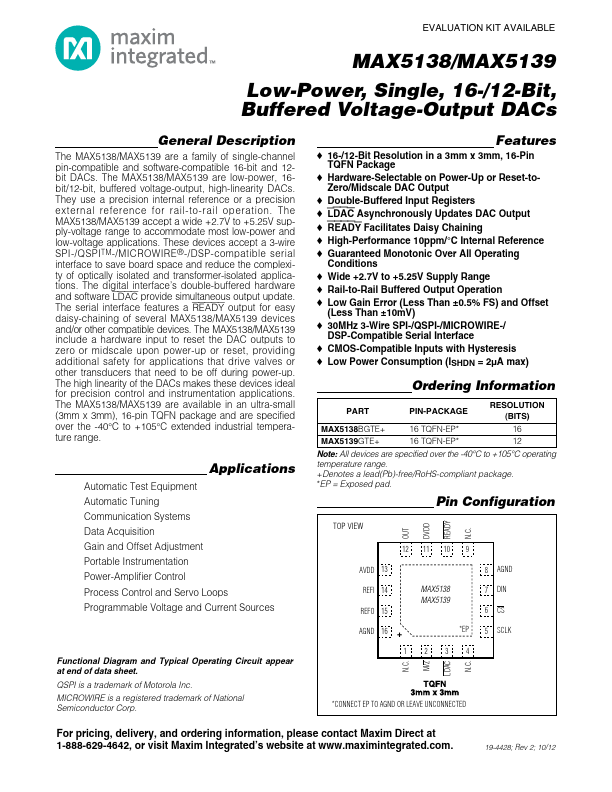
General Description Features o 16-/12-Bit Resolution in a 3mm x 3mm, 16-Pin TQFN Package o Hardware-Selectable on Power-Up or Reset-to Zero/Midscale DAC Output o Double-Buffered Input Registers o LDAC Asynchronously Updates DAC Output o READY Facilitates Daisy Chaining o High-Performance 10ppm/°C Internal Reference o Guaranteed Monotonic Over All Operating Conditions o Wide +2.7V to +5.25V Supply Range o Rail-to-Rail Buffered Output Operation o Low Gain Error (Less Than ±0.5% FS) and Offset (Less Than ±10m V) o 30MHz 3-Wire SPI-/QSPI-/MICROWIRE-/ DSP-patible Serial Interface o CMOS-patible Inputs with Hysteresis o Low Power Consumption (ISHDN = 2µA max)
MAX5138/MAX5139
..
The MAX5138/MAX5139 are a family of single-channel pin-patible and software-patible 16-bit and 12bit DACs. The MAX5138/MAX5139 are low-power, 16bit/12-bit, buffered voltage-output, high-linearity DACs. They use a precision internal reference or a precision external reference for rail-to-rail operation. The MAX5138/MAX5139 accept a wide +2.7V to +5.25V supply-voltage range to acmodate most low-power and low-voltage applications. These devices accept a 3-wire SPITM-/QSPITM-/MICROWIRETM-/DSP-patible serial interface to save board space and reduce the plexity of optically isolated and transformer-isolated applications. The digital interface’s double-buffered hardware and software LDAC provide simultaneous output update. The serial interface Features a READY output for easy daisy-chaining of several MAX5138/MAX5139 devices and/or other patible devices. The MAX5138/MAX5139 include a hardware input to reset the DAC outputs to zero or midscale upon power-up or reset, providing additional safety for applications that drive valves or other transducers that need to be off during power-up. The high linearity of the DACs makes these devices ideal for...