MAX9879
MAX9879 is Stereo Class D Audio Subsystem manufactured by Maxim Integrated.
19-4436; Rev 0; 2/09
KIT ATION EVALU E L B A AVAIL
Stereo Class D Audio Subsystem with Direct Drive Headphone Amplifier
Features
- Better than 9d B Margin Under EN 55022 Class B Limits with No Filter ponents
- Low RF Susceptibility Design Rejects TDMA Noise from GSM Radios
- Input Mixer with User Defined Input Mode
- Stereo 715m W Speaker Output (RL = 8Ω, VDD = 3.7V)
- Stereo 58m W Headphone Output (16Ω, VDD = 3.7V)
- Low 0.04% THD+N at 1k Hz (Class D Power Amplifier)
- Low 0.018% THD+N at 1k Hz (Headphone Amplifier)
- 88% Efficiency (RL = 8Ω, POUT = 750m W)
- 1.6Ω Analog Switch for Speaker Amplifier Bypass
- High Speaker Amplifier PSRR (72d B at 217Hz)
- High Headphone Amplifier PSRR (84d B at 217Hz)
- I2C Control
- Hardware and Software Shutdown Mode
- Ultra-Low Click and Pop
- Robust Design with Current and Thermal Protection
- Available in Space-Saving Package 5x6 UCSP (2.5mm x 3mm)
..
General Description
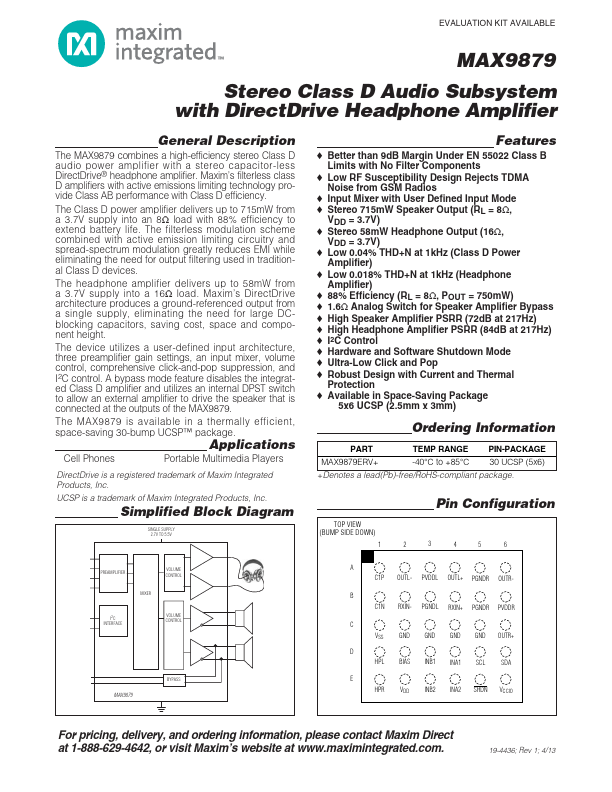
The MAX9879 bines a high-efficiency stereo Class D audio power amplifier with a stereo capacitor-less Direct Drive® headphone amplifier. Maxim’s filterless class D amplifiers with active emissions limiting technology provide Class AB performance with Class D efficiency. The Class D power amplifier delivers up to 715m W from a 3.7V supply into an 8Ω load with 88% efficiency to extend battery life. The filterless modulation scheme bined with active emission limiting circuitry and spread-spectrum modulation greatly reduces EMI while eliminating the need for output filtering used in traditional Class D devices. The headphone amplifier delivers up to 58m W from a 3.7V supply into a 16 Ω load. Maxim’s patented Direct Drive architecture produces a ground-referenced output from a single supply, eliminating the need for large DC-blocking capacitors, saving cost, space and ponent height. The device utilizes a user-defined input architecture, three preamplifier gain settings, an input mixer, volume control, prehensive click-and-pop...