Datasheet4U Logo Datasheet4U.com

78M6610+LMU - Energy Measurement Processor

Download the 78M6610+LMU datasheet PDF. This datasheet also covers the 78M6610LMU variant, as both devices belong to the same energy measurement processor family and are provided as variant models within a single manufacturer datasheet.

General Description

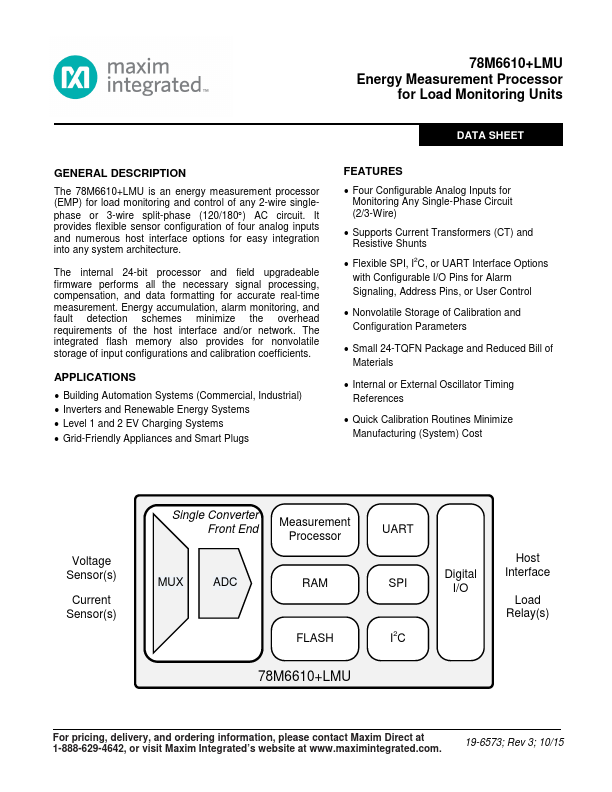
The 78M6610+LMU is an energy measurement processor (EMP) for load monitoring and control of any 2-wire singlephase or 3-wire split-phase (120/180°) AC circuit.

Key Features

  • Four Configurable Analog Inputs for Monitoring Any Single-Phase Circuit (2/3-Wire).
  • Supports Current Transformers (CT) and Resistive Shunts.
  • Flexible SPI, I2C, or UART Interface Options with Configurable I/O Pins for Alarm Signaling, Address Pins, or User Control.
  • Nonvolatile Storage of Calibration and Configuration Parameters.
  • Small 24-TQFN Package and Reduced Bill of Materials.
  • Internal or External Oscillator Timing References.
  • Qu.

📥 Download Datasheet

Note: The manufacturer provides a single datasheet file (78M6610LMU-MaximIntegrated.pdf) that lists specifications for multiple related part numbers.

Full PDF Text Transcription (Reference)

The following content is an automatically extracted verbatim text from the original manufacturer datasheet and is provided for reference purposes only.

View original datasheet text
78M6610+LMU Energy Measurement Processor for Load Monitoring Units DATA SHEET GENERAL DESCRIPTION The 78M6610+LMU is an energy measurement processor (EMP) for load monitoring and control of any 2-wire singlephase or 3-wire split-phase (120/180°) AC circuit. It provides flexible sensor configuration of four analog inputs and numerous host interface options for easy integration into any system architecture. The internal 24-bit processor and field upgradeable firmware performs all the necessary signal processing, compensation, and data formatting for accurate real-time measurement. Energy accumulation, alarm monitoring, and fault detection schemes minimize the overhead requirements of the host interface and/or network.