

Datasheet4U Logo Datasheet4U.com

ICL7117 - Digit A/D Converter

Download the ICL7117 datasheet PDF. This datasheet also covers the ICL7116 variant, as both devices belong to the same digit a/d converter family and are provided as variant models within a single manufacturer datasheet.

General Description

The Maxim ICL7116 and ICL7117 are 3½ digit monolithic analog-to-digital converters.

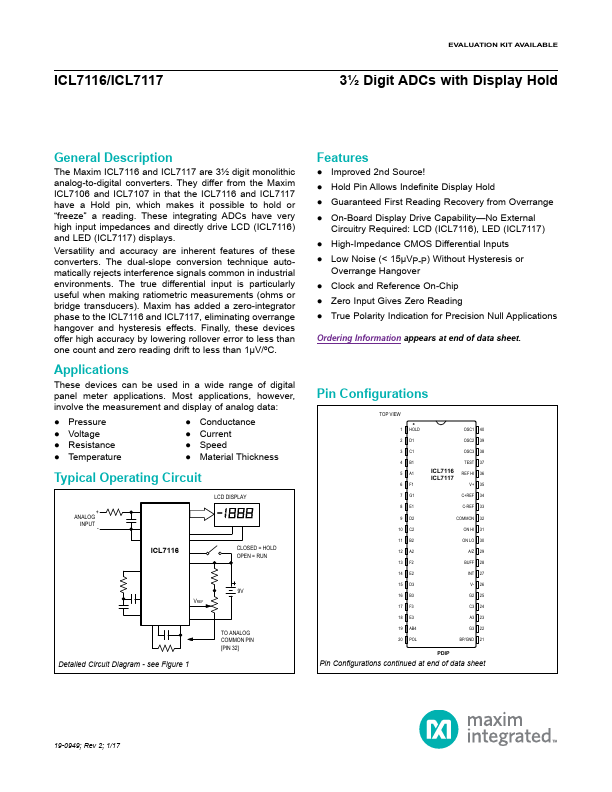
They differ from the Maxim ICL7106 and ICL7107 in that the ICL7116 and ICL7117 have a Hold pin, which makes it possible to hold or “freeze” a reading.
Key Features

  • of these converters. The dual-slope conversion technique auto­ matically rejects interference signals common in industrial environments. The true differential input is particularly useful when making ratiometric measurements (ohms or bridge transducers). Maxim has added a zero-integrator phase to the ICL7116 and ICL7117, eliminating overrange hangover and hysteresis effects. Finally, these devices offer high accuracy by lowering rollover error to less than one count and zero reading drift to les.

📥 Download Datasheet

Note: The manufacturer provides a single datasheet file (ICL7116_MaximIntegratedProducts.pdf) that lists specifications for multiple related part numbers.

Full PDF Text Transcription (Reference)

The following content is an automatically extracted verbatim text from the original manufacturer datasheet and is provided for reference purposes only.

View original datasheet text
ICL7116/ICL7117 EVALUATION KIT AVAILABLE 3½ Digit ADCs with Display Hold General Description The Maxim ICL7116 and ICL7117 are 3½ digit monolithic analog-to-digital converters. They differ from the Maxim ICL7106 and ICL7107 in that the ICL7116 and ICL7117 have a Hold pin, which makes it possible to hold or “freeze” a reading. These integrating ADCs have very high input impedances and directly drive LCD (ICL7116) and LED (ICL7117) displays. Versatility and accuracy are inherent features of these converters. The dual-slope conversion technique auto­ matically rejects interference signals common in industrial environments. The true differential input is particularly useful when making ratiometric measurements (ohms or bridge transducers).