

Datasheet4U Logo Datasheet4U.com

MAX15005A - 4.5V to 40V Input Automotive Flyback/Boost/SEPIC Power-Supply Controllers

Download the MAX15005A datasheet PDF. This datasheet also covers the MAX15004A variant, as both devices belong to the same 4.5v to 40v input automotive flyback/boost/sepic power-supply controllers family and are provided as variant models within a single manufacturer datasheet.

General Description

The MAX15004A/B/MAX15005A/B high-performance, current-mode PWM controllers operate at an automotive input voltage range from 4.5V to 40V (load dump).

The input voltage can go lower than 4.5V after startup if IN is bootstrapped to a boosted output voltage.
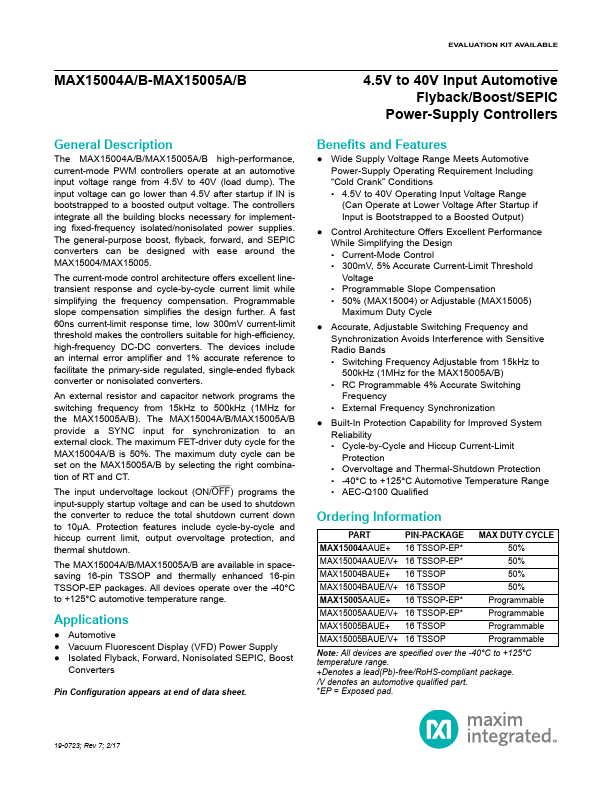
Key Features

  • include cycle-by-cycle and hiccup current limit, output over-voltage protection, and thermal shutdown. The MAX15004A/B/MAX15005A/B are available in spacesaving 16-pin TSSOP and thermally enhanced 16-pin TSSOP-EP packages. All devices operate over the -40°C to +125°C automotive temperature range.

📥 Download Datasheet

Note: The manufacturer provides a single datasheet file (MAX15004A-MaximIntegrated.pdf) that lists specifications for multiple related part numbers.

Full PDF Text Transcription (Reference)

The following content is an automatically extracted verbatim text from the original manufacturer datasheet and is provided for reference purposes only.

View original datasheet text
EVALUATION KIT AVAILABLE MAX15004A/B-MAX15005A/B General Description The MAX15004A/B/MAX15005A/B high-performance, current-mode PWM controllers operate at an automotive input voltage range from 4.5V to 40V (load dump). The input voltage can go lower than 4.5V after startup if IN is bootstrapped to a boosted output voltage. The controllers integrate all the building blocks necessary for implementing fixed-frequency isolated/nonisolated power supplies. The general-purpose boost, flyback, forward, and SEPIC converters can be designed with ease around the MAX15004/ MAX15005. The current-mode control architecture offers excellent linetransient response and cycle-by-cycle current limit while simplifying the frequency compensation. Programmable slope compensation simplifies the design further.