Datasheet4U Logo Datasheet4U.com

MAX17600 - Dual MOSFET Drivers

Download the MAX17600 datasheet PDF. This datasheet also covers the MAX17601 variant, as both devices belong to the same dual mosfet drivers family and are provided as variant models within a single manufacturer datasheet.

General Description

The MAX17600

MAX17605 devices are high-speed MOSFET drivers capable of sinking /sourcing 4A peak currents.

The devices have various inverting and noninverting part options that provide greater flexibility in controlling the MOSFET.

Key Features

  • Dual Drivers with Enable Inputs.
  • +4V to +14V Single Power-Supply Range.
  • 4A Peak Sink /Source Current.
  • Inputs Rated to +14V, Regardless of VDD Voltage.
  • Low 12ns Propagation Delay.
  • 6ns Typical Rise and 5ns Typical Fall Times with 1nF Load.
  • Matched Delays Between Channels.
  • Parallel Operation of Dual Outputs for Larger Driver Output Current.
  • TTL or HNM Logic-Level Inputs with Hysteresis for Noise Immunity.

📥 Download Datasheet

Note: The manufacturer provides a single datasheet file (MAX17601_MaximIntegratedProducts.pdf) that lists specifications for multiple related part numbers.

Full PDF Text Transcription (Reference)

The following content is an automatically extracted verbatim text from the original manufacturer datasheet and is provided for reference purposes only.

View original datasheet text
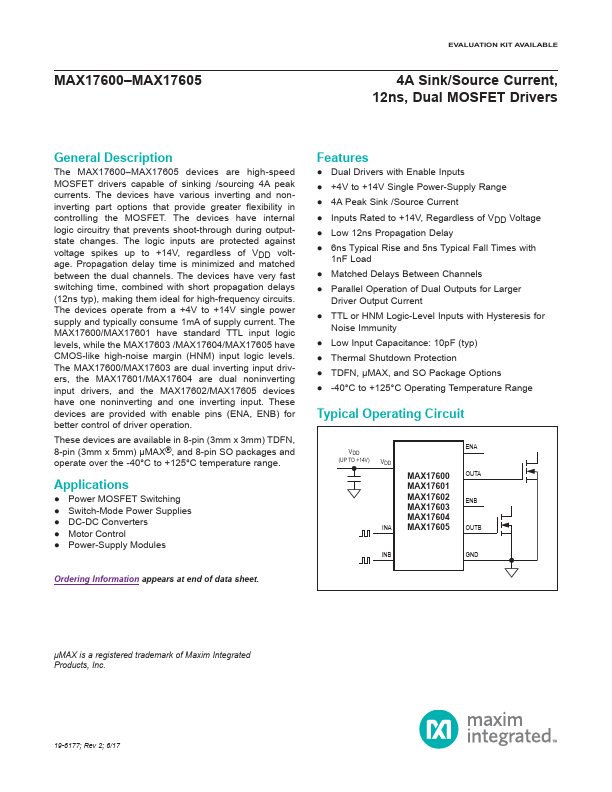
MAX17600–MAX17605 EVALUATION KIT AVAILABLE 4A Sink/Source Current, 12ns, Dual MOSFET Drivers General Description The MAX17600–MAX17605 devices are high-speed MOSFET drivers capable of sinking /sourcing 4A peak currents. The devices have various inverting and noninverting part options that provide greater flexibility in controlling the MOSFET. The devices have internal logic circuitry that prevents shoot-through during outputstate changes. The logic inputs are protected against voltage spikes up to +14V, regardless of VDD voltage. Propagation delay time is minimized and matched between the dual channels. The devices have very fast switching time, combined with short propagation delays (12ns typ), making them ideal for high-frequency circuits.