Datasheet4U Logo Datasheet4U.com

MAX2442 - 900MHz Image-Reject Receivers

Download the MAX2442 datasheet PDF. This datasheet also covers the MAX2440 variant, as both devices belong to the same 900mhz image-reject receivers family and are provided as variant models within a single manufacturer datasheet.

General Description

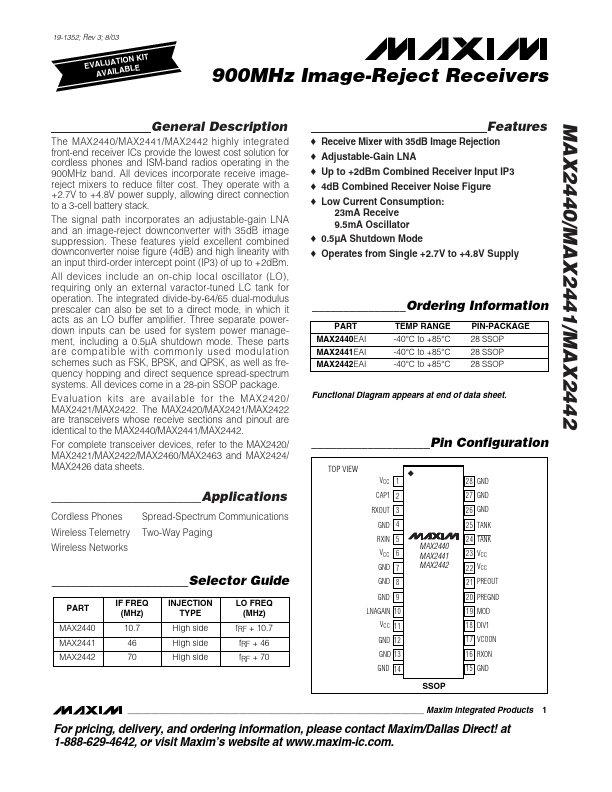
The MAX2440/MAX2441/MAX2442 highly integrated front-end receiver ICs provide the lowest cost solution for cordless phones and ISM-band radios operating in the 900MHz band.

All devices incorporate receive imagereject mixers to reduce filter cost.

Key Features

  • yield excellent combined downconverter noise figure (4dB) and high linearity with an input third-order intercept point (IP3) of up to +2dBm. All devices include an on-chip local oscillator (LO), requiring only an external varactor-tuned LC tank for operation. The integrated divide-by-64/65 dual-modulus prescaler can also be set to a direct mode, in which it acts as an LO buffer amplifier. Three se.

📥 Download Datasheet

Note: The manufacturer provides a single datasheet file (MAX2440_MaximIntegratedProducts.pdf) that lists specifications for multiple related part numbers.

Full PDF Text Transcription (Reference)

The following content is an automatically extracted verbatim text from the original manufacturer datasheet and is provided for reference purposes only.

View original datasheet text
19-1352; Rev 0; 4/98 EVAALVUAAILTAIOBNLEKIT 900MHz Image-Reject Receivers MAX2440/MAX2441/MAX2442 General Description The MAX2440/MAX2441/MAX2442 highly integrated front-end receiver ICs provide the lowest cost solution for cordless phones and ISM-band radios operating in the 900MHz band. All devices incorporate receive imagereject mixers to reduce filter cost. They operate with a +2.7V to +4.8V power supply, allowing direct connection to a 3-cell battery stack. The signal path incorporates an adjustable-gain LNA and an image-reject downconverter with 35dB image suppression. These features yield excellent combined downconverter noise figure (4dB) and high linearity with an input third-order intercept point (IP3) of up to +2dBm.