Datasheet4U Logo Datasheet4U.com

MAX978 - Low-Power Comparators

Download the MAX978 datasheet PDF. This datasheet also covers the MAX976 variant, as both devices belong to the same low-power comparators family and are provided as variant models within a single manufacturer datasheet.

General Description

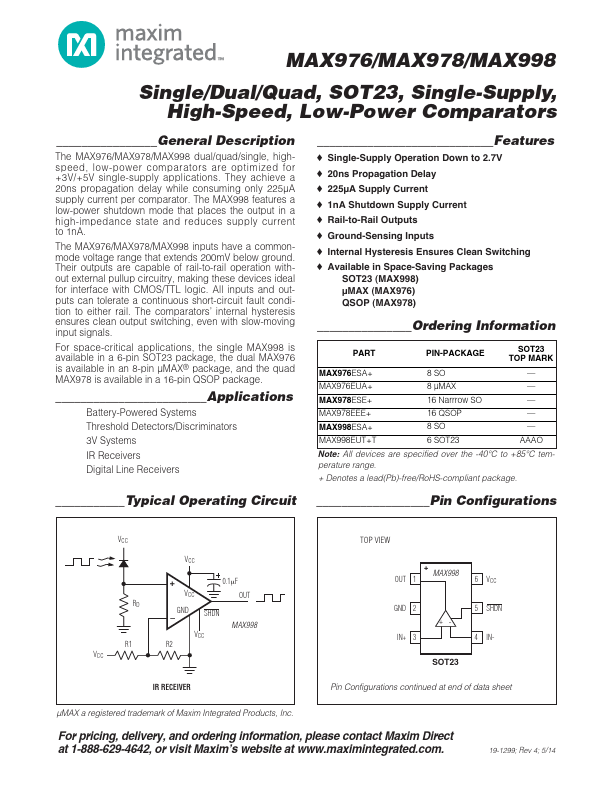
The MAX976/MAX978/MAX998 dual/quad/single, highspeed, low-power comparators are optimized for +3V/+5V single-supply applications.

They achieve a 20ns propagation delay while consuming only 225µA supply current per comparator.

Key Features

  • a low-power shutdown mode that places the output in a high-impedance state and reduces supply current to 1nA. The MAX976/MAX978/MAX998 inputs have a commonmode voltage range that extends 200mV below ground. Their outputs are capable of rail-to-rail operation without external pullup circuitry, making these devices ideal for interface with CMOS/TTL logic. All inputs and outputs can tolerate a continuous short-circuit fault condition to either rail. The comparators’ internal hysteresis ensures clea.

📥 Download Datasheet

Note: The manufacturer provides a single datasheet file (MAX976_MaximIntegratedProducts.pdf) that lists specifications for multiple related part numbers.

Full PDF Text Transcription (Reference)

The following content is an automatically extracted verbatim text from the original manufacturer datasheet and is provided for reference purposes only.

View original datasheet text
19-1299; Rev 3; 3/09 MAX976/MAX978/MAX998 Single/Dual/Quad, SOT23, Single-Supply, High-Speed, Low-Power Comparators ________________General Description The MAX976/MAX978/MAX998 dual/quad/single, highspeed, low-power comparators are optimized for +3V/+5V single-supply applications. They achieve a 20ns propagation delay while consuming only 225µA supply current per comparator. The MAX998 features a low-power shutdown mode that places the output in a high-impedance state and reduces supply current to 1nA. The MAX976/MAX978/MAX998 inputs have a commonmode voltage range that extends 200mV below ground. Their outputs are capable of rail-to-rail operation without external pullup circuitry, making these devices ideal for interface with CMOS/TTL logic.