MAX14628
MAX14628 is Low-Power Headset Detectors manufactured by Maxim Integrated.
- Part of the MAX14627 comparator family.
- Part of the MAX14627 comparator family.
Description
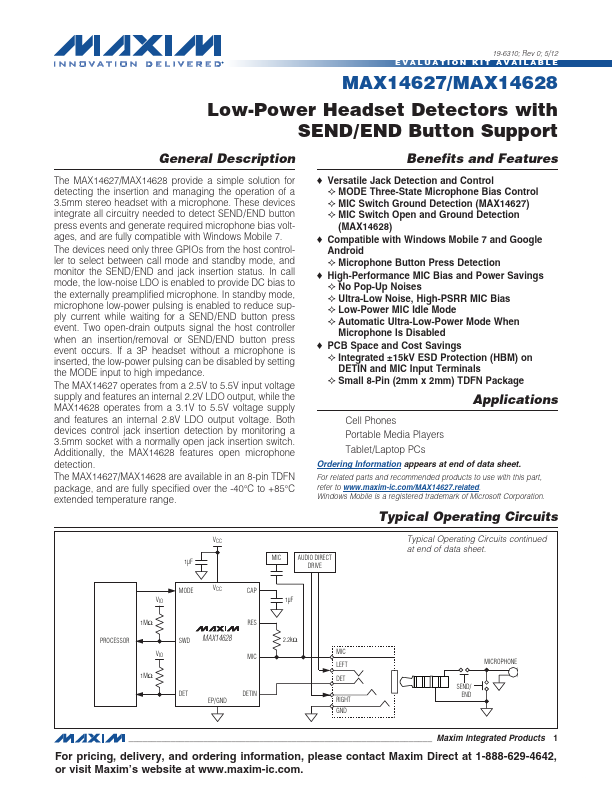
The MAX14627/MAX14628 provide a simple solution for detecting the insertion and managing the operation of a 3.5mm stereo headset with a microphone. These devices integrate all circuitry needed to detect SEND/END button press events and generate required microphone bias voltages, and are fully patible with Windows Mobile 7. The devices need only three GPIOs from the host controller to select between call mode and standby mode, and monitor the SEND/END and jack insertion status. In call mode, the low-noise LDO is enabled to provide DC bias to the externally preamplified microphone. In standby mode, microphone low-power pulsing is enabled to reduce supply current while waiting for a SEND/END button press event. Two open-drain outputs signal the host controller when an insertion/removal or SEND/END button press event occurs. If a 3P headset without a microphone is inserted, the low-power pulsing can be disabled by setting the MODE input to high impedance. The MAX14627 operates from a 2.5V to 5.5V input voltage supply and features an internal 2.2V LDO output, while the MAX14628 operates from a 3.1V to 5.5V voltage supply and features an internal 2.8V LDO output voltage. Both devices control jack insertion detection by monitoring a 3.5mm socket with a normally open jack insertion switch. Additionally, the MAX14628 features open microphone detection. The MAX14627/MAX14628 are available in an 8-pin TDFN package, and are fully specified over the -40NC to +85NC extended temperature range.
Benefits and Features
S Versatile Jack Detection and Control
- MODE Three-State Microphone Bias Control
- MIC Switch Ground Detection (MAX14627)
- MIC Switch Open and Ground Detection (MAX14628) S patible with Windows Mobile 7 and Google Android
- Microphone Button Press Detection S High-Performance MIC Bias and Power Savings
- No Pop-Up Noises
- Ultra-Low Noise, High-PSRR MIC Bias
- Low-Power MIC Idle Mode
- Automatic Ultra-Low-Power Mode When Microphone Is...