• Part: MAX17558
  • Description: Step-Down Controller
  • Manufacturer: Maxim Integrated
  • Size: 811.63 KB
Download MAX17558 Datasheet PDF
Maxim Integrated
MAX17558
MAX17558 is Step-Down Controller manufactured by Maxim Integrated.
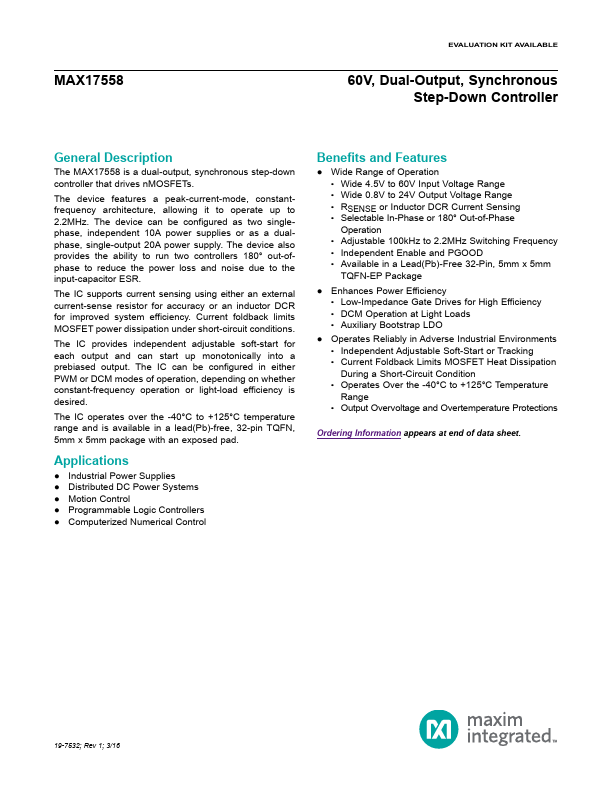
EVALUATION KIT AVAILABLE 60V, Dual-Output, Synchronous Step-Down Controller General Description The MAX17558 is a dual-output, synchronous step-down controller that drives n MOSFETs. The device uses a constant-frequency, peak-current-mode architecture. The two outputs can be configured as independent voltage rails. Input capacitor size can be minimized by running the two outputs 180º out-of-phase. The IC supports current sensing using either an external current-sense resistor for accuracy or an inductor DCR for improved system efficiency. Current foldback limits MOSFET power dissipation under short-circuit conditions. The IC provides independent adjustable soft-start for each output and can start up monotonically into a prebiased output. The IC can be configured in either PWM or DCM modes of operation, depending on whether constant-frequency operation or light-load efficiency is desired. The IC operates over the -40°C to +125°C temperature range and is available in a lead(Pb)-free, 32-pin TQFN, 5mm x 5mm package. Applications - - Industrial Power Supplies - - Distributed DC Power Systems - - Motion Control - - Programmable Logic Controllers - - puterized Numerical Control Benefits and Features - - Wide Range of Operation - Wide 4.5V to 60V Input Voltage Range - Wide 0.8V to 24V Output Voltage Range - RSENSE or Inductor DCR Current-Sensing - Selectable In-Phase or 180° Out-of-Phase Operation - Adjustable 100k Hz to 2.2MHz Switching Frequency - Independent Enable and PGOOD - Available in a Lead(Pb)-Free 32-Pin, 5mm x 5mm TQFN Package - - Enhances Power Efficiency - Low Impedence Gate Drives for High Efficiency - DCM Operation at Light Loads - Auxiliary Bootstrap LDO - - Operates Reliably in Adverse Industrial Environments - Independent Adjustable Soft-Start or Tracking - Current Foldback Limits MOSFET Heat Dissipation During a Short-Circuit...